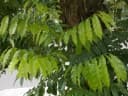
Andira inermis
Andira inermis
Safety & Hazards
Many members of this genus are used medicinally, particularly to treat parasitic and other skin conditions, and to act as a drastic purgative. The powdered wood, bark and seeds are the parts most commonly used. However the medicinal use of these plants needs to be tempered with caution since the active compounds (the alkaloid andirine is most commonly mentioned) are toxic and, in all but small doses, can cause fever, delerium, vomiting and, in extreme cases, death[1, 2]. Both caster oil (from Ricinus communis) and lemon juice are said to be effective antidotes[1]. The smoke from the wood is said to be toxic and to cause blindness if it gets in the eyes[3, 2].
Cultivation Details
Andira inermis is native to lowland tropical areas, especially along the sides of rivers, it grows best in lowlands that are periodically inundated[4, 3]. It succeeds best at elevations ranging from sea level to 400 metres, though it can be found as high as 900 metres[4]. It is found mainly in areas where the temperature varies from 28 to 35°c, and annual rainfall from 2,500 to 6,500 mm, though it can also succeed in drier areas of savannah vegetation[4, 3]. Tolerant of a wide range of soil conditions, succeeding on well-drained sandy soils as well as on poorly drained clay soils[4]. Grows best in a fertile, moisture-retentive soil[3]. Prefers a position in full sun or partial shade[3]. Established plants are moderately drought tolerant[3]. Plants are moderately tolerant of salt-laden winds[3]. Plants can flower twice a year when growing in drier woodlands, though it flowers less often in more humid climates[3]. It is an important source of nectar for bees[3]. The plant has earned its common name of 'Cabbage Bark' because its bark smells like a foetid cabbage[3]. In the wild, this tree offers a suitable environment for some plant epiphytes like orchids, bromeliads, mosses and ferns[4]. This species has a symbiotic relationship with certain soil bacteria, these bacteria form nodules on the roots and fix atmospheric nitrogen. Some of this nitrogen is utilized by the growing plant but some can also be used by other plants growing nearby[5].
Propagation
Seed - the large, hard seeds need to be scarified before planting - making a cut on the hard fruit endocarp with a file and then planting them in seed beds or plastic bags is recommended[4]. The seed does well when sown directly. Two to three seeds per station are planted directly in the field[4]. Seeds start to germinate at week 5 and maximum germination is observed at week 16. Germination rate is 43% - 56%[4]. One year-old plants 50 cm tall or more can be transplanted during the rainy season[4]. Seedlings require low light for establishment and more light for development. In the field, little or no management is necessary[4]. Cite as: Tropical Plants Database, Ken Fern. tropical.theferns.info. 2026-02-19. <tropical.theferns.info/viewtropical.php?id=Andira+inermis>
Pollinators
Bees, Insects
References
- [1]Diccionario das Plantas Uteis do Brasil — Correa M.P. · Imprensa Nacional; Rio de Janeiro · 1926 ↩︎A massive work in 6 volumes giving details of the various uses of Brazilian plants.
- [2]Indicador de Madeiras e Plantas Uteis do Brasil. — Fonseca E. T. De · Officinas graphicas Villas-Boas & Co.; Rio de Janeiro · 1922 · http://www.biodiversitylibrary.org ↩︎Brief details of some of the uses of Brazilian plants. It can be downloaded from the Internet.
- [3]Tropical and Subtropical Trees - A Worldwide Encyclopaedic Guide. — Barwick. M. · Thames & Hudson, London · 2004 · ISBN 0-500-51181-0 ↩︎A superb book, very concise and well written, giving a wealth of information on 400 or more species including descriptions, habitat, cultivation details and plant uses. A wealth of colour photographs bring each plant vividly to life.
- [4]World Agroforesty Centre — http://www.worldagroforestry.org/ ↩︎An excellent online database of a huge range of trees giving very good information on each plant - its uses, ecology, identity, propagation, pests etc.
- [5]Nodulation Plants in GRIN Taxonomy — United States Department of Agriculture · http://www.ars-grin.gov/~sbmljw/cgi-bin/taxnodul.pl?language=en ↩︎An online database listing plants that have either positive or negative reports on root and stem nodulation with nitrogen-fixing bacteria.
- [6]Present and Potential Commercial Timbers of the Caribbean — Longwood.F.R. · USDA Forest Service; Washington, DC. · 1962 ↩︎Quite detailed information on more than 60 species of Caribbean timber trees, giving species descriptions, habitat, detailed info on the wood and some info on other uses. Available for download on the internet.
- [7]Monograph of Andira (Leguminosae-Papilionoideae) — Pennington R.T. · 2003 ↩︎
- [8]Flora of Guatemala — Standley P.C. & J. A. Steyermark · 1946 - 1976 · http://www.archive.org/ ↩︎A superb reference, though somewhat dated. Gives lots of plant uses as well as information on plant habit and habitat. The entire flora (13 volumes) can now be downloaded from http://www.archive.org/
- [9]The Leguminosae; A Source Book of Characteristics, Uses and Nodulation — Allen O.N.; Allen E.K. · University of Wisconsin · 1981 · ISBN 0-333-32221-5 ↩︎An amazing and comprehensive work, giving a brief guide to the many genera of the family Fabaceae and also the principle uses of the genus.
- [10]The New RHS Dictionary of Gardening. 1992. — Huxley. A. · MacMillan Press · 1992 · ISBN 0-333-47494-5 ↩︎Excellent and very comprehensive, though it contains a number of silly mistakes. Readable yet also very detailed.
- [11]IUCN Red List of Threatened Species — http://www.iucnredlist.org/ ↩︎A list of plants under threat and facing possible extinction, usually with brief details of the threats and information on habitat.
- [12]Medicinal Plants of the Guianas — DeFilipps, R. A.; Maina, S. L.; & Crepin, J. · Smithsonian Museum · http://botany.si.edu/bdg/medicinal/index.html ↩︎A down-loadable PDF document of a book in pre-publication awaiting illustration. An excellent, if rather terse, guide to the traditional medicinal uses of the plants of the region
- [13]Medicinal Plants of Brazil — Mors W.B.; Rizzini C.T.; Pereira N.A. · Reference Publications; Michigan. · 2000 · ISBN 0-917256-42-5 ↩︎An extremely concise book, listing approximately 1,500 species and varieties of plants with their botanical name, common name in Brazil, regions in Brazil where the plant is found, a brief list of uses and any medically active compounds in the plant.
- [14]Trees and Shrubs of Mexico — Standley P.C. · Smithsonian Institution; Washington · 1926 ↩︎Although dated, it contains a wealth of information on the trees and shrubs of Mexico, including many of their uses. It can be downloaded from the Internet.
- [15]Elsevier’s Dictionary of Trees, Volume 1 North America: With Names in Latin, English, French, Spanish and other lang — Grandtner M.M. · Elsevier B.V.; Amsterdam, The Netherlands · 2005 · ISBN 0-444-51784-7 ↩︎
- [16]Tropical Timbers of the World. Ag. Handbook No. 607. — Chudnoff. Martin. · USDA Forest Service. Wisconsin. · 1984 ↩︎Terse details on the properties of the wood of almost 400 species of trees from the Tropics.