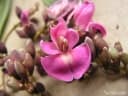
Andira fraxinifolia
Andira fraxinifolia
Safety & Hazards
Many members of this genus are used medicinally, particularly to treat parasitic and other skin conditions, and to act as a drastic purgative. The powdered wood, bark and seeds are the parts most commonly used. However the medicinal use of these plants needs to be tempered with caution since the active compounds (the alkaloid andirine is most commonly mentioned) are toxic and, in all but small doses, can cause fever, delerium, vomiting and, in extreme cases, death[1, 2]. Both caster oil (from Ricinus communis) and lemon juice are said to be effective antidotes[1]. The smoke from the wood is said to be toxic and to cause blindness if it gets in the eyes[3, 2].
Cultivation Details
Grows best in a sunny position[4]. Young plants have a moderate rate of growth, able to reach a height of around 2.5 metres within 2 years from seed[4]. This species has a symbiotic relationship with certain soil bacteria, these bacteria form nodules on the roots and fix atmospheric nitrogen. Some of this nitrogen is utilized by the growing plant but some can also be used by other plants growing nearby[5].
Propagation
Seed - best sown as soon as it is ripe, placing the large seeds in a partially shaded position in individual containers. A germination rate in excess of 80% can be expected if the seed is sown fresh, with the seed sprouting within 15 - 35 days[4]. The seedlings develop slowly, but they should be ready to plant out 8 - 9 months later[4]. Cite as: Tropical Plants Database, Ken Fern. tropical.theferns.info. 2026-02-19. <tropical.theferns.info/viewtropical.php?id=Andira+fraxinifolia>
Pollinators
Bees, Insects
References
- [1]Diccionario das Plantas Uteis do Brasil — Correa M.P. · Imprensa Nacional; Rio de Janeiro · 1926 ↩︎A massive work in 6 volumes giving details of the various uses of Brazilian plants.
- [2]Indicador de Madeiras e Plantas Uteis do Brasil. — Fonseca E. T. De · Officinas graphicas Villas-Boas & Co.; Rio de Janeiro · 1922 · http://www.biodiversitylibrary.org ↩︎Brief details of some of the uses of Brazilian plants. It can be downloaded from the Internet.
- [3]Tropical and Subtropical Trees - A Worldwide Encyclopaedic Guide. — Barwick. M. · Thames & Hudson, London · 2004 · ISBN 0-500-51181-0 ↩︎A superb book, very concise and well written, giving a wealth of information on 400 or more species including descriptions, habitat, cultivation details and plant uses. A wealth of colour photographs bring each plant vividly to life.
- [4]Brazilian Trees. Volume 1. 4th Edition. — Lorenzi. H. · Instituto Plantarum De Estudos Da Flora; Brazil. · 2002 · ISBN 85-86714-17-8 ↩︎Information on 350 species of Brazilian trees. Stunning photographs of each species, brief details on the plant, its uses and how to grow it from seed. A superb work, with the minor irritation that the translation from Portuguese is not of the best.
- [5]Nodulation Plants in GRIN Taxonomy — United States Department of Agriculture · http://www.ars-grin.gov/~sbmljw/cgi-bin/taxnodul.pl?language=en ↩︎An online database listing plants that have either positive or negative reports on root and stem nodulation with nitrogen-fixing bacteria.
- [6]Monograph of Andira (Leguminosae-Papilionoideae) — Pennington R.T. · 2003 ↩︎
- [7]Dictionary of Trees; Volume 2 South America; Nomenclature, Taxonomy and Ecology — Grandtner M.M. & Chevrette J. · Academic Press; London · 2014 · ISBN 978-0-12-396490-8 ↩︎
- [8]IUCN Red List of Threatened Species — http://www.iucnredlist.org/ ↩︎A list of plants under threat and facing possible extinction, usually with brief details of the threats and information on habitat.
- [9]Medicinal Plants of Brazil — Mors W.B.; Rizzini C.T.; Pereira N.A. · Reference Publications; Michigan. · 2000 · ISBN 0-917256-42-5 ↩︎An extremely concise book, listing approximately 1,500 species and varieties of plants with their botanical name, common name in Brazil, regions in Brazil where the plant is found, a brief list of uses and any medically active compounds in the plant.