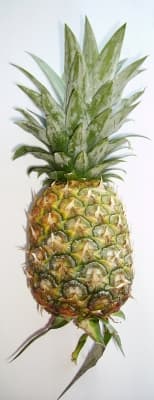
Ananas comosus
Ananas comosus
Safety & Hazards
None known
Cultivation Details
A plant of the moist, mainly lowland tropics, where it can also be found at elevations up to 1,800 metres. It grows best in areas where annual daytime temperatures are within the range 21 - 30°c, but can tolerate 10 - 36°c[1]. The plant can be damaged or killed if temperatures drop to 5°c for any prolonged period of time, and is killed by even a short period at 0°c[1]. It prefers a mean annual rainfall in the range 800 - 2,500mm, but tolerates 550 - 3,500mm[1]. Plants can tolerate full sun to fairly dark shade[2]. Prefers a light, well-drained, humus-rich soil that is on the acid side[3, 4]. Prefers a pH in the range 4.5 - 8, tolerating 3.5 - 9[1]. Established plants are very drought tolerant[2]. Commercial cultivation is largely limited to latitudes between 25°S - 25°N, but it can also be found to 33°S[1]. Fruits tend to be smaller and less sweet when grown at higher elevations and most pineapples are grown near the sea in areas with a high atmospheric humidity often on hill slopes[1]. The plant requires 11 - 36 months from planting until the first crop of fruit. When grown commercially, the plant has an economic life of just 2 - 3 years, though the plant may continue to live and fruit for over 50 years[1]. The optimum yield is 60 - 80 tonnes/ha for the first harvest; the first ratoon crop yields approximately 10% less; the second ratoon crop 30% less[1]. A shallow-rooted plant[4]. Individual plants are self-sterile, but sexual fertilization is unnecessary because fruit is produced parthenocarpically[3]. There are many named varieties[5].
Propagation
Seed - cultivars do not breed true and so seed production is usually restricted to the search for new cultivars[6]. Crowns (leafy clumps atop mature fruits)[4]. Remove the leafy crown by twisting or cutting, remove any remaining yellow fruit attached to the crown then dry it for one or two days[4]. Place the crown in a moist potting soil mix or in water until roots appear[4]. Stem cuttings made after fruiting[6]. Remove the leaves from the stems, and cut into pieces or lay intact in trays, covering with 2cm of rooting medium[6]. Give bottom heat at around 20 - 27°c until roots are formed[6]. Lateral shoots[7]. Cite as: Tropical Plants Database, Ken Fern. tropical.theferns.info. 2026-02-19. <tropical.theferns.info/viewtropical.php?id=Ananas+comosus>
Pollinators
Data unavailable
References
- [1]Ecocrop — http://ecocrop.fao.org/ecocrop/srv/en/home ↩︎Basic information on a wide range of useful plants, plus details of environmental needs where available.
- [2]Institute of Food and Agricultural Sciences, University of Florida — University of Florida · http://hort.ifas.ufl.edu/shrubs/ ↩︎PDF fact sheets on over 500 shrubs.
- [3]Perennial Edible Fruits of the Tropics : an Inventory — Martin, F. W.; Campbell, C. W.; Rubertbe, R. M. · U.S. Dept. of Agriculture, Agricultural Research Service · 1987 ↩︎A booklet giving terse details of almost 300 species of edible fruits, plus regional lists of Botanical and Common names for over 2,500 less well-known edible fruits of the tropics.
- [4]KemperCentreForHomeGardeningPlantFinder — Missouri Botanical Garden · http://www.mobot.org/gardeninghelp/plantfinder/ ↩︎Basic cultivation details, plant uses, habitat etc for several thousand species of plants, mainly from the temperate zone.
- [5]Tropical Food Gardens — Norrington. L. · Bloomings Books (Melbourne) · 2001 · ISBN 1-876473-41-x ↩︎Excellent little book giving some basic information on a range of plants.
- [6]The New RHS Dictionary of Gardening. 1992. — Huxley. A. · MacMillan Press · 1992 · ISBN 0-333-47494-5 ↩︎Excellent and very comprehensive, though it contains a number of silly mistakes. Readable yet also very detailed.
- [7]Brazilian Fruits and Cultivated Exotics — Lorenzi. H.; Bacher. L.; Lacerda. M.; Sartori. S. · Instituto Plantarum De Estudos Da Flora LTDA; Brazil. · 2000 · ISBN 85-867174-24-0 ↩︎A superb book, giving information on several hundred fruit species. Each entry has a brief description of the plant and its uses, accompanied by one to many excellent quality photographs of the fruits.
- [8]Dictionary of Economic Plants. — Uphof. J. C. Th. · Weinheim · 1959 · ISBN - ↩︎An excellent and very comprehensive guide but it only gives very short descriptions of the uses without any details of how to utilize the plants. Not for the casual reader.
- [9]The Encyclopedia of Medicinal Plants — Chevallier. A. · Dorling Kindersley. London · 1996 · ISBN 9-780751-303148 ↩︎An excellent guide to over 500 of the more well known medicinal herbs from around the world.
- [10]Cornucopia II — Facciola. S. · Kampong Publications, California. · 1998 · ISBN 0-9628087-2-5 ↩︎The second edition of an excellent guide to the edible uses of plants, though it does not give any details of cultivation etc.
- [11]Medicinal Plants of the Guianas — DeFilipps, R. A.; Maina, S. L.; & Crepin, J. · Smithsonian Museum · http://botany.si.edu/bdg/medicinal/index.html ↩︎A down-loadable PDF document of a book in pre-publication awaiting illustration. An excellent, if rather terse, guide to the traditional medicinal uses of the plants of the region
- [12]Plants and People of Nepal — Manandhar. N. P. · Timber Press. Oregon. · 2002 · ISBN 0-88192-527-6 ↩︎Excellent book, covering over 1,500 species of useful plants from Nepal together with information on the geography and peoples of Nepal. Good descriptions of the plants with terse notes on their uses.
- [13]Useful Fiber Plants of the World — Dodge C.R. · USDA; Washington. · 1897 · http://www.biodiversitylibrary.org/ ↩︎A rather dated, but very comprehensive catalogue of fibre plants from around the world. The book can be downloaded from the Internet.