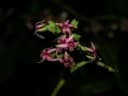
Anacardium occidentale
Anacardium occidentale
Safety & Hazards
The shell of the nut contains an acrid juice that acts as a powerful vesicant[1]. The active ingredient is cardole and it is poisonous in the same way as poison ivy (Toxicodendron spp.)[1, 2]. Very irritant to the skin, causing severe blistering[1]. It is destroyed by heat, so roasting the seed whilst in its shell renders it completely safe[1, 2].
Cultivation Details
A plant for lowland tropical and subtropical areas, succeeding at elevations up to 1,000 metres[3]. Grows well in hot, semi-arid, frost-free climates, fruiting well with an annual precipitation of 500 - 900mm[2]. It occurs in warm and humid climates with an annual rainfall of 1,000 - 3,500 mm[4, 3]. Prefers a pronounced dry season of 3 - 4 months[3]. Plants are not tolerant of frost, preferring a minimum temperature no lower than 18°c[5, 4]. Plants produce their best crops when grown not too far from the coast[1]. Cashews can also be grown satisfactorily in semi-arid areas but can show erratic production as a result of relative small variations in rainfall[3]. An easily grown plant requiring very little attention once established, it succeeds in soils that are too poor to support other crops[1, 2]. Prefers a well-drained sandy soil and a position in full sun[5]. The species can bear heavy, waterlogged clay soils or saline soils but with an extreme poor growth[6]. Brackish soils near seashores and inundated or swampy soils are not suited[6]. Tolerates a pH in the range 4.5 - 6.5[2]. Established plants are drought resistant[2, 3]. Tolerant of maritime exposure[1]. Early growth is usually rapid, with young trees sometimes flowering when only 18 months old[1]. Although slow-growing, it can commence bearing when only 4 - 5 years old[2, 7]. Trees are fast growing[3]. Trees have a productive life span of 30 - 40 years, normally beginning to bear in their third or fourth year and, under favourable conditions, attaining maximum production in around 7 years[3]. There are many named forms[2]. The flowers are fragrant[8]. The root system of a mature tree, when grown from seed, consists of a very prominent taproot and a well-developed and extensive network of lateral and sinker roots[4].
Propagation
Seed - traditionally sown in situ, germination usually taking place in 8 - 10 days[1]. 100% germination has been reported for seed that has been stored 4 months in open conditions, this drops to 50% after 10 months and zero after 14 months[4]. Plants produce a long tap root and do not always transplant very well[1]. Cuttings of ripe wood at the end of the growing season[5]. Layering. Cite as: Tropical Plants Database, Ken Fern. tropical.theferns.info. 2026-02-19. <tropical.theferns.info/viewtropical.php?id=Anacardium+occidentale>
Pollinators
Flies, Bees, Ants, Wind
References
- [1]Nuts. — Howes. F. N. · Faber · 1948 · ISBN - ↩︎Rather old but still a masterpiece. Has sections on tropical and temperate plants with edible nuts plus a section on nut plants in Britain. Very readable.
- [2]The New RHS Dictionary of Gardening. 1992. — Huxley. A. · MacMillan Press · 1992 · ISBN 0-333-47494-5 ↩︎Excellent and very comprehensive, though it contains a number of silly mistakes. Readable yet also very detailed.
- [3]Edible Nuts. — Wickens G.E. · FAO, Rome. · 1995 · http://www.fao.org/docrep/ · ISBN 92-5-103748-5 ↩︎Detailed information on 20 of the most valuable nut crops, plus more basic information on a wide range of other nut-producing plants. It can be downloaded from the Internet.
- [4]World Agroforesty Centre — http://www.worldagroforestry.org/ ↩︎An excellent online database of a huge range of trees giving very good information on each plant - its uses, ecology, identity, propagation, pests etc.
- [5]Encyclopaedia of Herbs and their Uses. — Bown. D. · Dorling Kindersley, London. · 1995 · ISBN 0-7513-020-31 ↩︎A very well presented and informative book on herbs from around the globe. Plenty in it for both the casual reader and the serious student. Just one main quibble is the silly way of having two separate entries for each plant.
- [6]Digital Compendium of Forestry Species of Cambodia — www.digitalspecies.blogspot.com; Phnom Penh · 2008 · http://www.digitalspecies.blogspot.com ↩︎A very detailed booklet, produced in PDF format on the internet, giving information on around 100 species of trees.
- [7]Tropical and Subtropical Trees - A Worldwide Encyclopaedic Guide. — Barwick. M. · Thames & Hudson, London · 2004 · ISBN 0-500-51181-0 ↩︎A superb book, very concise and well written, giving a wealth of information on 400 or more species including descriptions, habitat, cultivation details and plant uses. A wealth of colour photographs bring each plant vividly to life.
- [8]Plants of Guam — Moore P.H. & McMakin P. · University of Guam. · 1979 · http://university.uog.edu/cals/people/POG/scipn.htm ↩︎Brief details, usually with a photo, of plants native to the island of Guam, often together with some information on their uses. An online version is available.
- [9]Trees Commonly Cultivated in SE Asia — Jensen. M. · FAO Regional Office, Bangkok. · 1999 · ISBN 974-89377-5-5 ↩︎
- [10]Brazilian Trees. Volume 1. 4th Edition. — Lorenzi. H. · Instituto Plantarum De Estudos Da Flora; Brazil. · 2002 · ISBN 85-86714-17-8 ↩︎Information on 350 species of Brazilian trees. Stunning photographs of each species, brief details on the plant, its uses and how to grow it from seed. A superb work, with the minor irritation that the translation from Portuguese is not of the best.
- [11]Tropical Food Gardens — Norrington. L. · Bloomings Books (Melbourne) · 2001 · ISBN 1-876473-41-x ↩︎Excellent little book giving some basic information on a range of plants.
- [12]Edible Leaves of the Tropics — Martin. F. W.; Ruberte. R. M. & Meitzner. L. S. · Echo. USA. · 1998 · ISBN 0-9653360-1-8 ↩︎A terse guide, giving reasonable detail on the more common leaf crops and brief information on a wide range of lesser known plants.
- [13]The Encyclopedia of Medicinal Plants — Chevallier. A. · Dorling Kindersley. London · 1996 · ISBN 9-780751-303148 ↩︎An excellent guide to over 500 of the more well known medicinal herbs from around the world.
- [14]Levantamento etnobotânico de plantas popularmente utilizadas como antiúlceras e antiinflamatórias pela comunidade de — De Jesus, N.Z.T. et al · 2009 · ISBN 0102-695X ↩︎
- [15]Dictionary of Economic Plants. — Uphof. J. C. Th. · Weinheim · 1959 · ISBN - ↩︎An excellent and very comprehensive guide but it only gives very short descriptions of the uses without any details of how to utilize the plants. Not for the casual reader.
- [PFAF]Plants for a Future — pfaf.org ↩︎