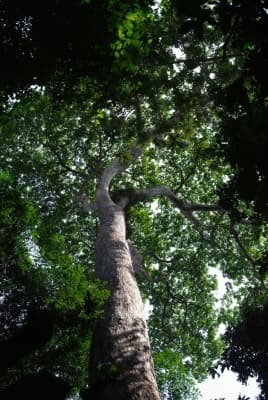
Amphimas pterocarpoides
Amphimas pterocarpoides
Safety & Hazards
None known
Cultivation Details
A plant of tropical forests, growing best in areas of high rainfall[1]. Requires a sunny position[1]. Seedlings tolerate some shade, but saplings require more light for proper growth, developing straight and unbranched stems until they are at least 70 cm tall[1]. Grows best in a rich soil[1]. Natural regeneration is generally abundant[1]. Trees usually flower when they are leafless in the dry season, the fruits take about 3 months to ripen[1]. Until recently the wood of this tree was considered to be of rather poor quality, but with the depletion of many commercial timber species it is becoming of more interest, especially for local construction and joinery, but presumably also for export in the future[1]. This species has a symbiotic relationship with certain soil bacteria, these bacteria form nodules on the roots and fix atmospheric nitrogen. Some of this nitrogen is utilized by the growing plant but some can also be used by other plants growing nearby[2].
Propagation
Seed - germinates within 5 - 15 days, but seedlings stop growth for a few weeks when they have developed the first 2 leaves[1]. Cite as: Tropical Plants Database, Ken Fern. tropical.theferns.info. 2026-02-19. <tropical.theferns.info/viewtropical.php?id=Amphimas+pterocarpoides>
Pollinators
Data unavailable
References
- [1]Protabase - Plant Resources of Tropical Africa. — http://www.prota.org ↩︎An excellent on-line database with detailed information on over 3,200 species of useful plants of Africa.
- [2]The New RHS Dictionary of Gardening. 1992. — Huxley. A. · MacMillan Press · 1992 · ISBN 0-333-47494-5 ↩︎Excellent and very comprehensive, though it contains a number of silly mistakes. Readable yet also very detailed.
- [3]The Leguminosae; A Source Book of Characteristics, Uses and Nodulation — Allen O.N.; Allen E.K. · University of Wisconsin · 1981 · ISBN 0-333-32221-5 ↩︎An amazing and comprehensive work, giving a brief guide to the many genera of the family Fabaceae and also the principle uses of the genus.
- [4]Tropix 7 — CIRAD · http://tropix.cirad.fr/en ↩︎An on-line guide to the timbers of 245 species of trees.