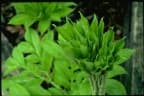
Amorphophallus paeoniifolius
Amorphophallus paeoniifolius
Safety & Hazards
The tuber of the wild species is considered to be totally toxic and inedible, the wild plant only being used for medicineal purposes[1]. Although no specific mention has been seen for the cultivated forms of species, it belongs to a family where most of the members contain calcium oxalate crystals. This substance is toxic fresh and, if eaten, makes the mouth, tongue and throat feel as if hundreds of small needles are digging in to them. However, calcium oxalate is easily broken down either by thoroughly cooking the plant or by fully drying it and, in either of these states, it is safe to eat the plant. People with a tendency to rheumatism, arthritis, gout, kidney stones and hyperacidity should take especial caution if including this plant in their diet[2].
Cultivation Details
A temperature in the range of 25 - 35°c is required with an annual rainfall of 1,000 - 1,500mm[3]. Corm development is promoted during dry periods[3]. Cultivated for its edible tuber in Asia, plants are not winter hardy outdoors in the temperate zone, but are sometimes grown as part of a sub-tropical bedding display in temperate areas with a long, warm, frost-free season[4]. The best crops are produced on deep, fertile, alluvial soils that are slightly acid[3]. Dislikes heavy clay soils[3]. Plants require some shade, especially when young, in the tropics, but grow better in a sunny position in temperate areas[3]. Members of this genus generally require a moist but well-drained, humus-rich, fertile soil and a position in dappled shade[5]. The plants are usually grown on a three year cycle in the tropics[3]. An interesting technique used in Indonesia is to dig up the tuber after one year and then replant it upside down. This stimulates the lateral buds into growth and increases the overall size of the tuber[5]. In temperate zones the tuber is harvested in the autumn after top growth has been cut back by frost and it must be kept quite dry and frost-free over winter[4, 6]. It is then potted up in a warm greenhouse in spring ready to be planted out about 15cm deep after the last expected frosts. Yields of 20 tonnes per hectare can be achieved[3]. There are many cultivated forms, some of which have a lower content of calcium oxalate crystals and less or no alkaloids[5]. The plant produces one or two enormous leaves and one short flowering stem annually. When ripe for pollination, the flowers have a foetid smell to attract carrion flies and midges. This smell disappears once the flowers have been pollinated[7]. Like many species in the family Araceae, this plant has the ability to heat the flowering spadix as the pollen becomes ready for fertilization. This heat greatly increases the strength of the aroma released by the plant, thus attracting more pollinating insects. It can also have the effect of making the insects more active, thus increasing the level of fertilization[5].
Propagation
Seed - best sown in a pot in a warm greenhouse as soon as it is ripe and the pot sealed in a plastic bag to retain moisture. It usually germinates in 1 - 8 months at 24°c[6]. When large enough to handle, prick the seedlings out into individual pots and grow them on in the greenhouse for at least a couple of years. Plant them out in late spring or early summer, after the last expected frosts, and give them some protection such as a cloche until they are growing away strongly. Cite as: Temperate Plants Database, Ken Fern. temperate.theferns.info. 2026-02-20. <temperate.theferns.info/plant/Amorphophallus+paeoniifolius>
Pollinators
Flies
References
- [1]Medicinal Plants in Papua New Guinea — World Health Organisation · 2009 · ISBN 978-92-9061-249-0 ↩︎Traditional medicinal uses of 126 species from Papua New Guinea, including information on modern research into the plants.
- [2]Encyclopaedia of Herbs and their Uses. — Bown. D. · Dorling Kindersley, London. · 1995 · ISBN 0-7513-020-31 ↩︎A very well presented and informative book on herbs from around the globe. Plenty in it for both the casual reader and the serious student. Just one main quibble is the silly way of having two separate entries for each plant.
- [3]Vegetables in the Tropics — Tindall. H. D. · MacMillan, Oxford. · 1983 · ISBN 0-333-24268-8 ↩︎An excellent, in-depth look at the main vegetable crops that can be grown in the Tropics, plus many less well-known plants.
- [4]RHS Dictionary of Plants plus Supplement. 1956 — F. Chittendon. · Oxford University Press · 1951 · ISBN - ↩︎Comprehensive listing of species and how to grow them. Somewhat outdated, it has been replaced in 1992 by a new dictionary (see [ 200 ]).
- [5]Aroids: Plants of the Arum Family. — Bown D. · Timber Press; Portland, Oregon. · 2000 · ISBN 0-88192-485-7 ↩︎An excellent treatment of the family Araceae, giving lots of information about the plants, how to grow them, their uses etc. I found it a bit disordered - if you want all the information on a specific species you have to trawl through the whole book.
- [6]Growing from Seed. Volume 1. — Rice. G. (Editor) · Thompson and Morgan. · 1987 · ISBN - ↩︎Very readable magazine with lots of information on propagation.
- [7]Scented Flora of the World. — Genders. R. · Robert Hale. London. · 1994 · ISBN 0-7090-5440-8 ↩︎An excellent, comprehensive book on scented plants giving a few other plant uses and brief cultivation details. There are no illustrations.
- [8]Sturtevant's Edible Plants of the World. — Hedrick. U. P. · Dover Publications · 1972 · ISBN 0-486-20459-6 ↩︎Lots of entries, quite a lot of information in most entries and references.
- [9]The New RHS Dictionary of Gardening. 1992. — Huxley. A. · MacMillan Press · 1992 · ISBN 0-333-47494-5 ↩︎Excellent and very comprehensive, though it contains a number of silly mistakes. Readable yet also very detailed.
- [10]Flora of China — Missouri Botanical Garden Press; St. Louis. · 1994 · http://flora.huh.harvard.edu/china/ ↩︎An excellent, comprehensive resource in 25 volumes. In addition to the botanical information the flora also gives basic information on habitat and some uses. An on-line version is also available.
- [11]A Modern Herbal. — Grieve. · Penguin · 1984 · ISBN 0-14-046-440-9 ↩︎Not so modern (1930's?) but lots of information, mainly temperate plants.
- [12]Flowering Plants of the World. — Haywood. V. H. · Oxford University Press · ISBN 0-19-217674-9 ↩︎Very readable and well illustrated, it lists plants by families giving the basic diagnostic features and some details of plant uses.
- [13]Tanaka's Cyclopedia of Edible Plants of the World. — Tanaka. T. & Nakao S. · Keigaku Publishing; Tokyo · 1976 · ISBN - ↩︎The most comprehensive list of edible plants I've come across. Only the briefest entry for each species, though, and some of the entries are more than a little dubious. Not for the casual reader.
- [14]Dictionary of Economic Plants. — Uphof. J. C. Th. · Weinheim · 1959 · ISBN - ↩︎An excellent and very comprehensive guide but it only gives very short descriptions of the uses without any details of how to utilize the plants. Not for the casual reader.
- [15]A Dictionary of Plants Used by Man. — Usher. G. · Constable · 1974 · ISBN 0094579202 ↩︎Forget the sexist title, this is one of the best books on the subject. Lists a very extensive range of useful plants from around the world with very brief details of the uses. Not for the casual reader.
- [16]Medicinal Plants of Nepal — Dept. of Medicinal Plants. Nepal. · 1993 · ISBN - ↩︎Terse details of the medicinal properties of Nepalese plants, including cultivated species and a few imported herbs.
- [17]Cornucopia - A Source Book of Edible Plants. — Facciola. S. · Kampong Publications · 1990 · ISBN 0-9628087-0-9 ↩︎Excellent. Contains a very wide range of conventional and unconventional food plants (including tropical) and where they can be obtained (mainly N. American nurseries but also research institutes and a lot of other nurseries from around the world.
- [18]Glossary of Indian Medicinal Plants (Including the Supplement). — Chopra. R. N., Nayar. S. L. and Chopra. I. C. · Council of Scientific and Industrial Research, New Delhi. · 1986 · ISBN - ↩︎Very terse details of medicinal uses of plants with a wide range of references and details of research into the plants chemistry. Not for the casual reader.
- [19]Plants and People of Nepal — Manandhar. N. P. · Timber Press. Oregon. · 2002 · ISBN 0-88192-527-6 ↩︎Excellent book, covering over 1,500 species of useful plants from Nepal together with information on the geography and peoples of Nepal. Good descriptions of the plants with terse notes on their uses.
- [PFAF]Plants for a Future — pfaf.org ↩︎