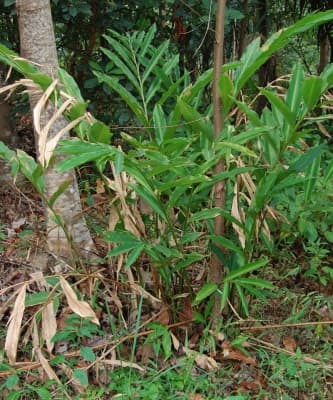
Amomum compactum
Amomum compactum
Safety & Hazards
None known
Cultivation Details
Round cardamom is a plant of the moist tropics. It grows best in areas where the mean annual temperature is in the range 23 - 28°c, tolerating daily temperatures from 10 - 35°c. It requires a constant high relative humidity, with a mean annual rainfall of 2,500 - 4,000mm, and at least 136 rainy days[1].It can be found at elevations from 200 - 1,000 metres, though the greatest yields are obtained at 300 - 500 metres[1]. Requires a position in partial shade. Grows best in a fertile, moist, humus-rich soil that is well-drained. Prefers a pH in the range 5 - 6.8[1]. During the first years of growth, flowers produce hardly any fruit[1]. New inflorescences develop continuously from the 3rd or 4th year and produce fruits that mature 6 - 8 weeks after flowering. Rainfall (or irrigation) promotes flowering, while fruit-set is increased by the presence of pollinating insects[1]. When mature, the fruit feels firm, the corolla has been shed, and the skin is wrinkled and reddish-purple. Harvesting is carried out by cutting the entire fruit cluster and then removing the individual fruits[1]. From the 4th year onwards the fruit can be harvested every 35 - 45 days. In Java, for example, four small harvests are possible between January and July (rainy season) and 3 larger ones between August and December (dry season)[1]. Yields are quite low in the first few years. Dry fruit yield can reach 275 kilos per hectare during the second year, gradually rising to 475 kilos in subsequent years[1].
Propagation
Seed - Rhizome cuttings or offsets of the plant clump[1]. The rhizome cutting or offset (with rhizome part and adventitious roots) should bear 1 - 2 shoot buds or young plantlets 10 - 15cm tall, each with 4-8 leaves. Under dry weather conditions some of the lower leaves are removed to prevent rapid dehydration. Planting holes 50 cm deep and wide are first prepared, the soil is loosened and organic matter is incorporated. One or two cuttings are planted per hole, being placed about 10 cm deep. Cite as: Tropical Plants Database, Ken Fern. tropical.theferns.info. 2026-02-19. <tropical.theferns.info/viewtropical.php?id=Amomum+compactum>
Pollinators
Insects
References
- [1]Plant Resources of Southeast Asia — http://proseanet.org/ ↩︎Lots of information on the uses of the plants of SE Asia.
- [2]Dictionary of Economic Plants. — Uphof. J. C. Th. · Weinheim · 1959 · ISBN - ↩︎An excellent and very comprehensive guide but it only gives very short descriptions of the uses without any details of how to utilize the plants. Not for the casual reader.
- [3]Cornucopia II — Facciola. S. · Kampong Publications, California. · 1998 · ISBN 0-9628087-2-5 ↩︎The second edition of an excellent guide to the edible uses of plants, though it does not give any details of cultivation etc.