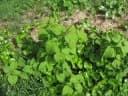
Amaranthus viridis
Amaranthus viridis
Safety & Hazards
No members of this genus are known to be poisonous, but when grown on nitrogen-rich soils they are known to concentrate nitrates in the leaves. This is especially noticeable on land where chemical fertilizers are used. Nitrates are implicated in stomach cancers, blue babies and some other health problems. It is inadvisable, therefore, to eat this plant if it is grown inorganically.
Cultivation Details
Originally from the American tropics, the plant can be cultivated in a wide range of zones from the temperate through to many parts of the tropics. Prefers a well-drained fertile soil in a sunny position[1]. Requires a hot sheltered position if it is to do well[PFAF]. Plants are particularly susceptible to attacks by leaf-chewing insects[2]. Plants should not be given inorganic fertilizers, see notes above on toxicity. Cultivated as a food plant in the tropics[3]. Most if not all members of this genus photosynthesize by a more efficient method than most plants. Called the 'C4 carbon-fixation pathway', this process is particularly efficient at high temperatures, in bright sunlight and under dry conditions[4].
Propagation
Seed - sow late spring in situ. An earlier sowing can be made in a greenhouse and the plants put out after the last expected frosts. Germination is usually rapid and good if the soil is warm[5], but poor germination rates are experienced in cool or cold soils[6]. A drop in temperature overnight aids germination[5]. Cuttings of growing plants root easily[7]. Cite as: Temperate Plants Database, Ken Fern. temperate.theferns.info. 2026-02-20. <temperate.theferns.info/plant/Amaranthus+viridis>
Pollinators
Wind, Self
References
- [1]The New RHS Dictionary of Gardening. 1992. — Huxley. A. · MacMillan Press · 1992 · ISBN 0-333-47494-5 ↩︎Excellent and very comprehensive, though it contains a number of silly mistakes. Readable yet also very detailed.
- [2]Edible Leaves of the Tropics — Martin. F. W.; Ruberte. R. M. & Meitzner. L. S. · Echo. USA. · 1998 · ISBN 0-9653360-1-8 ↩︎A terse guide, giving reasonable detail on the more common leaf crops and brief information on a wide range of lesser known plants.
- [3]Dictionary of Economic Plants. — Uphof. J. C. Th. · Weinheim · 1959 · ISBN - ↩︎An excellent and very comprehensive guide but it only gives very short descriptions of the uses without any details of how to utilize the plants. Not for the casual reader.
- [4]Lost Crops of the Incas — Popenoe. H. et al · National Academy Press · 1990 · ISBN 0-309-04264-X ↩︎An excellent book. Very readable, with lots of information and good pictures of some lesser known food plants of S. America.
- [5]Growing from Seed. Volume 1. — Rice. G. (Editor) · Thompson and Morgan. · 1987 · ISBN - ↩︎Very readable magazine with lots of information on propagation.
- [6]The National Non-Food Crops Centre Crop Database — http://www.nnfcc.co.uk/crops/pd.cfm ↩︎An excellent on-line information source, with information on over 100 species (as of 2006) of plants being investigated as bio-crops.
- [7]Oriental Vegetables — Larkcom J. · John Murray · 1991 · ISBN 0-7195-4781-4 ↩︎Well written and very informative.
- [8]Protabase - Plant Resources of Tropical Africa. — http://www.prota.org ↩︎An excellent on-line database with detailed information on over 3,200 species of useful plants of Africa.
- [9]Pacific Island Ecosystems at Risk — http://www.hear.org/pier/scientificnames/index.html ↩︎A very good website detailing weed species that have been introduced into the Pacific Islands.
- [10]Wild Food in Australia. — Cribb. A. B. and J. W. · Fontana · 1976 · ISBN 0-00-634436-4 ↩︎A very good pocket guide.
- [11]A Dictionary of Plants Used by Man. — Usher. G. · Constable · 1974 · ISBN 0094579202 ↩︎Forget the sexist title, this is one of the best books on the subject. Lists a very extensive range of useful plants from around the world with very brief details of the uses. Not for the casual reader.
- [12]Plants for Human Consumption. — Kunkel. G. · Koeltz Scientific Books · 1984 · ISBN 3874292169 ↩︎An excellent book for the dedicated. A comprehensive listing of Latin names with a brief list of edible parts.
- [13]Cornucopia - A Source Book of Edible Plants. — Facciola. S. · Kampong Publications · 1990 · ISBN 0-9628087-0-9 ↩︎Excellent. Contains a very wide range of conventional and unconventional food plants (including tropical) and where they can be obtained (mainly N. American nurseries but also research institutes and a lot of other nurseries from around the world.
- [14]Medicinal Plants of China — Duke. J. A. and Ayensu. E. S. · Reference Publications, Inc. · 1985 · ISBN 0-917256-20-4 ↩︎Details of over 1,200 medicinal plants of China and brief details of their uses. Often includes an analysis, or at least a list of constituents. Heavy going if you are not into the subject.
- [15]Flora of China — Missouri Botanical Garden Press; St. Louis. · 1994 · http://flora.huh.harvard.edu/china/ ↩︎An excellent, comprehensive resource in 25 volumes. In addition to the botanical information the flora also gives basic information on habitat and some uses. An on-line version is also available.
- [16]Glossary of Indian Medicinal Plants (Including the Supplement). — Chopra. R. N., Nayar. S. L. and Chopra. I. C. · Council of Scientific and Industrial Research, New Delhi. · 1986 · ISBN - ↩︎Very terse details of medicinal uses of plants with a wide range of references and details of research into the plants chemistry. Not for the casual reader.
- [17]Plants and People of Nepal — Manandhar. N. P. · Timber Press. Oregon. · 2002 · ISBN 0-88192-527-6 ↩︎Excellent book, covering over 1,500 species of useful plants from Nepal together with information on the geography and peoples of Nepal. Good descriptions of the plants with terse notes on their uses.
- [18]Nature's Colors - Dyes from Plants. — Grae. I. · MacMillan Publishing Co. New York. · 1974 · ISBN 0-02-544950-8 ↩︎A very good and readable book on dyeing.
- [PFAF]Plants for a Future — pfaf.org ↩︎