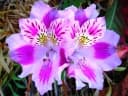
Alstroemeria pelegrina
Alstroemeria pelegrina
Safety & Hazards
The fresh sap of this plant can cause skin rashes in some people. The plant contains up to 2% of the compound tuliposide A, which probably hydrolizes on the skin to form the allergenic lactone tulipalin A. People who are allergic to the sap of tulips are very likely to also be sensitive to the sap of this plant[1, 2].
Cultivation Details
A plant of the drier subtropics, it cannot tolerate freezing conditions and prefers growing not too far from the coast where temperatures do not get too high[3]. One report says that it is possibly hardy to about -10°c[4]. Another report suggests that plants will only tolerate light frosts, but they should prove hardy in selected sites in the mildest areas of the temperate zone[5]. It grows in areas of low rainfall ranging from 100 - 800mm, with a dry season that can last more than 6 months[3]. Requires a fertile, moisture retentive well-drained soil and a warm situation in semi-shade[5, 3]. Prefers a dry sheltered border and a peaty loam[6]. Requires a well-drained soil that stays moist in the summer[4]. Plants succeed in maritime gardens[7]. Established plants are very drought tolerant[3]. Somewhat intolerant of root disturbance[6], the roots are fleshy and brittle[5].
Propagation
Seed - best sown in individual pots in a cold frame as soon as it is ripe although seedlings can be transplanted successfully if they are moved with care whilst small. Pre-soak stored seed for 12 hrs in warm water, warm stratify for 4 weeks at 25°c and then reduce the temperature to 10°c. Excising a small bit of the seed near the embryo after the seed has been warm stratified helps to speed up the germination process[8]. Plant out about 20cm deep into their permanent positions in late summer or autumn[5]. Division in mid spring or early autumn with care since the plant resents root disturbance[9]. Ensure each portion has a growth bud[10]. Cite as: Temperate Plants Database, Ken Fern. temperate.theferns.info. 2026-02-20. <temperate.theferns.info/plant/Alstroemeria+pelegrina>
Pollinators
Insects
References
- [1]A Colour Atlas of Poisonous Plants. — Frohne. D. and Pfänder. J. · Wolfe · 1984 · ISBN 0723408394 ↩︎Brilliant. Goes into technical details but in a very readable way. The best work on the subject that I've come across so far.
- [2]BoDD (Botanical Dermatology Database) — http://bodd.cf.ac.uk/ ↩︎Brief notes on a very wide range of plants that have reports of causing harm to the skin.
- [3]ChileFlora — http://www.chileflora.com/index.html ↩︎Not realy a flora, but a lovely site with lots of helpful information for the gardener and an abundance of excellent photos covering over 2,000 species of Chilean plants.
- [4]Perennials. Volumes 1 and 2. — Phillips. R. & Rix. M. · Pan Books · 1991 · ISBN 0-330-30936-9 ↩︎Photographs of over 3,000 species and cultivars of ornamental plants together with brief cultivation notes, details of habitat etc.
- [5]The New RHS Dictionary of Gardening. 1992. — Huxley. A. · MacMillan Press · 1992 · ISBN 0-333-47494-5 ↩︎Excellent and very comprehensive, though it contains a number of silly mistakes. Readable yet also very detailed.
- [6]RHS Dictionary of Plants plus Supplement. 1956 — F. Chittendon. · Oxford University Press · 1951 · ISBN - ↩︎Comprehensive listing of species and how to grow them. Somewhat outdated, it has been replaced in 1992 by a new dictionary (see [ 200 ]).
- [7]Perennial Garden Plants — Thomas. G. S. · J. M. Dent & Sons, London. · 1990 · ISBN 0 460 86048 8 ↩︎A concise guide to a wide range of perennials. Lots of cultivation guides, very little on plant uses.
- [8]Growing from Seed. Volume 4. — Bird. R. (Editor) · Thompson and Morgan. · 1990 · ISBN - ↩︎Very readable magazine with lots of information on propagation. A good article on Yuccas, one on Sagebrush (Artemesia spp) and another on Chaerophyllum bulbosum.
- [9]Growing from Seed. Volume 1. — Rice. G. (Editor) · Thompson and Morgan. · 1987 · ISBN - ↩︎Very readable magazine with lots of information on propagation.
- [10]Popular Hardy Perennials. — Sanders. T. W. · Collingridge · 1926 · ISBN - ↩︎A fairly wide range of perennial plants that can be grown in Britain and how to grow them.
- [11]KemperCentreForHomeGardeningPlantFinder — Missouri Botanical Garden · http://www.mobot.org/gardeninghelp/plantfinder/ ↩︎Basic cultivation details, plant uses, habitat etc for several thousand species of plants, mainly from the temperate zone.
- [12]Plants for Human Consumption. — Kunkel. G. · Koeltz Scientific Books · 1984 · ISBN 3874292169 ↩︎An excellent book for the dedicated. A comprehensive listing of Latin names with a brief list of edible parts.