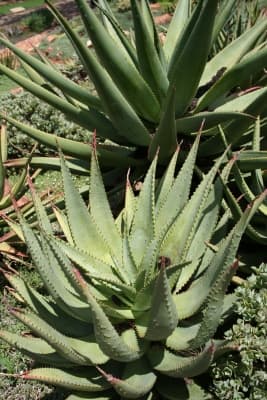
Aloe ferox
Aloe ferox
Safety & Hazards
The sap of Aloe species contains anthraquinones. These compounds have several beneficial medicinal actions, particularly as a laxative, and many species of Aloe are thus employed in traditional medicine. Whilst safe in small doses and for short periods of time, anthraquinones do have potential problems if used in excess. These include congestion and irritation of the pelvic organs[1]. Long term use of anthraquinone laxatives may also play a role in development of colorectal cancer as they have genotoxic potential, and tumorigenic potential[1].
Cultivation Details
Aloe ferox is indigenous to the arid subtropical areas of South Africa, but it is now widely grown throughout the tropics and subtropics[1]. It grows in a wide range of climatic conditions. It is especially abundant where mean temperatures range from 27 - 31°c and annual rainfall ranges from 50 - 300mm[1]. Plants can withstand light frost, with occasional short-lived temperatures as low as -4°c, although the flowers may be damaged at -2°c[1, 2]. Requires a sunny position and a very well-drained soil. Thrives on rich soils[1], but is also tolerant of poor ones[3]. Aloe species follow the Crassulacean acid metabolism (CAM). CAM plants are able to fix CO2 at night and to photosynthesize with closed stomata during the day, thus minimizing water loss. This, plus their succulent leaves and stems and the presence of a thick cuticle, makes them well adapted to dry conditions. Severe drought, though, stops exudate production[1]. Although the root system is shallow, the plant can grow under very dry conditions[1]. A slow-growing plant[2]. Cape aloe has a stem surrounded with a persistent layer of dead leaves that insulate it in the case of bush fires[1]. Harvesting of Aloe ferox leaves for medicinal purposes could thus result in significant mortality due to fires[1].
Propagation
Seed - sow in a well drained medium in shallow trays and cover lightly with sand or the seed will blow away[4]. Once the seeds begin to germinate, keep moist but watch out for overwatering as the seedlings could rot[4]. Transplant into small pots or bags once they are about 4cm high (approximately 6 months)[4]. Plants can also be propagated by planting of the tops of old plants[1]. Plant regeneration from root and embryo tissue is successful as well[1]. Cite as: Tropical Plants Database, Ken Fern. tropical.theferns.info. 2026-02-19. <tropical.theferns.info/viewtropical.php?id=Aloe+ferox>
Pollinators
Birds, Bees
References
- [1]Protabase - Plant Resources of Tropical Africa. — http://www.prota.org ↩︎An excellent on-line database with detailed information on over 3,200 species of useful plants of Africa.
- [2]Desert Tropicals — http://www.desert-tropicals.com/ ↩︎The main focus of the site is succulent plants, but it also contains information on a wide range of other species. Usually at least one good photograph, plus basic information about the plant and its cultivation.
- [3]The New RHS Dictionary of Gardening. 1992. — Huxley. A. · MacMillan Press · 1992 · ISBN 0-333-47494-5 ↩︎Excellent and very comprehensive, though it contains a number of silly mistakes. Readable yet also very detailed.
- [4]PlantZAfrica.com — http://www.plantzafrica.com ↩︎An excellent site giving detailed descriptions and uses of many S. African plants.
- [5]Flora of Southern Africa — Roux J.P. · 2003 · http://plants.jstor.org/search?st=662545 ↩︎An excellent on-line resource.
- [6]Cornucopia II — Facciola. S. · Kampong Publications, California. · 1998 · ISBN 0-9628087-2-5 ↩︎The second edition of an excellent guide to the edible uses of plants, though it does not give any details of cultivation etc.