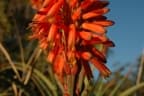
Aloe arborescens
Aloe arborescens
Safety & Hazards
The sap of Aloe species contains anthraquinones. These compounds have several beneficial medicinal actions, particularly as a laxative, and many species of Aloe are thus employed in traditional medicine. Whilst safe in small doses and for short periods of time, anthraquinones do have potential problems if used in excess. These include congestion and irritation of the pelvic organs[1]. Long term use of anthraquinone laxatives may also play a role in development of colorectal cancer as they have genotoxic potential, and tumorigenic potential[1].
Cultivation Details
A plant of the semi-arid to moist tropics, where it is found at elevations up to 2,000 metres. It grows best in areas where annual daytime temperatures are within the range 18 - 26°c, but can tolerate 9 - 38°c[2]. It can be killed by temperatures of -1°c or lower[2]. So long as the plant is not wet, it can tolerate occasional temperatures down to about -4°c[3]. It prefers a mean annual rainfall in the range 400 - 1,500mm, but tolerates 300 - 1,700mm[2]. Succeeds in full sun or light shade, requiring a well-drained, light to medium soil[2, 3]. Prefers a pH in the range 5 - 6.5, tolerating 4.2 - 7[2]. Established plants are drought tolerant[4]. This species hybridizes freely with several other Aloe species[4]. Aloe species follow the Crassulacean acid metabolism (CAM). CAM plants can fix carbon dioxide at night and photosynthesize with closed stomata during the day, thus minimizing water loss. This, plus their succulent leaves and stems, and the presence of a thick cuticle, makes them well adapted to dry conditions[1].
Propagation
Seed - sow in a sandy, well-drained potting soil in a warm, shady position in standard seed trays. Germination takes about three weeks. Cover with a thin layer of sand (1 - 2mm), keep moist and the seedlings can be planted out in individual bags or containers as soon as they are large enough to handle[4]. Stem cuttings 3 - 10cm long[1]. A branch or stem can be cut off, allowed to dry for a day or so until the wound has sealed, and then planted in well-drained soil or sand. It need not be rooted in any particular place and then transplanted, but can be placed directly into its permanent place in the garden. It is important to remember not to water the cutting too heavily; overwatering may cause it to rot[4]. Cite as: Tropical Plants Database, Ken Fern. tropical.theferns.info. 2026-02-19. <tropical.theferns.info/viewtropical.php?id=Aloe+arborescens>
Pollinators
Sunbirds, Bees
References
- [1]Protabase - Plant Resources of Tropical Africa. — http://www.prota.org ↩︎An excellent on-line database with detailed information on over 3,200 species of useful plants of Africa.
- [2]Ecocrop — http://ecocrop.fao.org/ecocrop/srv/en/home ↩︎Basic information on a wide range of useful plants, plus details of environmental needs where available.
- [3]Desert Tropicals — http://www.desert-tropicals.com/ ↩︎The main focus of the site is succulent plants, but it also contains information on a wide range of other species. Usually at least one good photograph, plus basic information about the plant and its cultivation.
- [4]PlantZAfrica.com — http://www.plantzafrica.com ↩︎An excellent site giving detailed descriptions and uses of many S. African plants.
- [5]Flora Zambesiaca — http://apps.kew.org/efloras/fz/intro.html ↩︎An excellent online flora of plants from the Zambezi River basin. It lists a number of the plant uses as well as the habitats and botanical descriptions of the plants.
- [6]Cornucopia II — Facciola. S. · Kampong Publications, California. · 1998 · ISBN 0-9628087-2-5 ↩︎The second edition of an excellent guide to the edible uses of plants, though it does not give any details of cultivation etc.
- [7]Flowers of India — http://www.flowersofindia.net/ ↩︎A wed site of native Indian plants, plus cultivated and naturalized species. It has good quality photos and terse details on more than 3,000 species and cultivars.