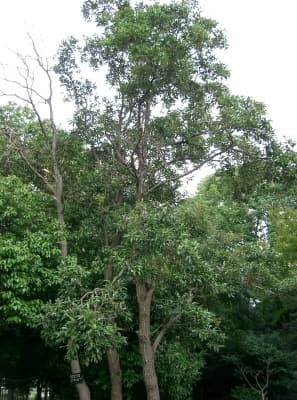
Alnus japonica
Alnus japonica
Safety & Hazards
None known
Cultivation Details
Alnus japonica is a plant mainly of temperate regions where it can experience very cold winters. It does also extend south to Taiwan where it enjoys a subtropical climate and is also cultivated in the Philippines, usually at higher elevations. Grows best in a sunny position, but is shade tolerant[1]. Prefers a heavy soil and a damp situation, but it succeeds in ordinary garden soil[2]. Grows well in heavy clay soils[2]. It does not require fertile soil, but prefers permeable soils and should not be planted in compact soils[3]. Thrives in drier soils than many members of this genus[4]. Tolerates very infertile sites[4]. Tolerant of inundation of the soil, under such conditions the tree retains its leaves and can almost maintain its growth rate by forming adventitious roots[1]. A fast-growing tree - on fertile sites, poles and firewood can be harvested after 5 years, small-diameter timber can be harvested in less than 10 years[3]. The tree responds well to coppicing[3]. This species has a symbiotic relationship with certain soil micro-organisms, these form nodules on the roots of the plants and fix atmospheric nitrogen. Some of this nitrogen is utilized by the growing plant but some can also be used by other plants growing nearby[4].
Propagation
Seed - best sown in a cold frame as soon as it is ripe and only just covered[4]. Spring sown seed should also germinate successfully so long as it is not covered[4, PFAF]. The seed should germinate in the spring as the weather warms up. When large enough to handle, prick the seedlings out into individual pots. If growth is sufficient, it is possible to plant them out into their permanent positions in the summer, otherwise keep them in pots outdoors and plant them out in the spring. If you have sufficient quantity of seed, it can be sown thinly in an outdoor seed bed in the spring[5]. The seedlings can either be planted out into their permanent positions in the autumn/winter, or they can be allowed to grow on in the seed bed for a further season before planting them. Cuttings of mature wood, taken as soon as the leaves fall in autumn, outdoors in sandy soil. Cite as: Temperate Plants Database, Ken Fern. temperate.theferns.info. 2026-02-20. <temperate.theferns.info/plant/Alnus+japonica>
Pollinators
Wind
References
- [1]Plant Resources of Southeast Asia — http://proseanet.org/ ↩︎Lots of information on the uses of the plants of SE Asia.
- [2]Trees and Shrubs Hardy in Great Britain. Vol 1 - 4 and Supplement. — Bean. W. · Murray · 1981 · ISBN - ↩︎A classic with a wealth of information on the plants, but poor on pictures.
- [3]World Agroforesty Centre — http://www.worldagroforestry.org/ ↩︎An excellent online database of a huge range of trees giving very good information on each plant - its uses, ecology, identity, propagation, pests etc.
- [4]The New RHS Dictionary of Gardening. 1992. — Huxley. A. · MacMillan Press · 1992 · ISBN 0-333-47494-5 ↩︎Excellent and very comprehensive, though it contains a number of silly mistakes. Readable yet also very detailed.
- [5]Propagation of Trees, Shrubs and Conifers. — Sheat. W. G. · MacMillan and Co · 1948 · ISBN - ↩︎A bit dated but a good book on propagation techniques with specific details for a wide range of plants.
- [6]Flora of the USSR. — Komarov. V. L. · Israel Program for Scientific Translation · 1968 · http://www.biodiversitylibrary.org · ISBN - ↩︎An immense (25 or more large volumes) and not yet completed translation of the Russian flora. Full of information on plant uses and habitats but heavy going for casual readers. It can be downloaded from the Internet.
- [7]IUCN Red List of Threatened Species — http://www.iucnredlist.org/ ↩︎A list of plants under threat and facing possible extinction, usually with brief details of the threats and information on habitat.
- [8]Philippine Medicinal Plants — http://www.stuartxchange.org/CompleteList.html ↩︎A lovely site, giving brief details on the medicinal uses of several hundred (over 400 at the last count) plants in the Philippines, plus a picture of each plant.
- [9]Cytotoxicity and Pharmacogenomics of Medicinal Plants from Traditional Korean Medicine — Kuete V.; Ean-Jeong Seo; Krusche B.; Oswald M.; Wiench B.; S · Hindawi Publishing Corporation · 2013 · http://dx.doi.org/10.1155/2013/341724 ↩︎
- [10]Medicinal Plants of China — Duke. J. A. and Ayensu. E. S. · Reference Publications, Inc. · 1985 · ISBN 0-917256-20-4 ↩︎Details of over 1,200 medicinal plants of China and brief details of their uses. Often includes an analysis, or at least a list of constituents. Heavy going if you are not into the subject.
- [11]Dictionary of Economic Plants. — Uphof. J. C. Th. · Weinheim · 1959 · ISBN - ↩︎An excellent and very comprehensive guide but it only gives very short descriptions of the uses without any details of how to utilize the plants. Not for the casual reader.
- [12]A Dictionary of Plants Used by Man. — Usher. G. · Constable · 1974 · ISBN 0094579202 ↩︎Forget the sexist title, this is one of the best books on the subject. Lists a very extensive range of useful plants from around the world with very brief details of the uses. Not for the casual reader.
- [PFAF]Plants for a Future — pfaf.org ↩︎