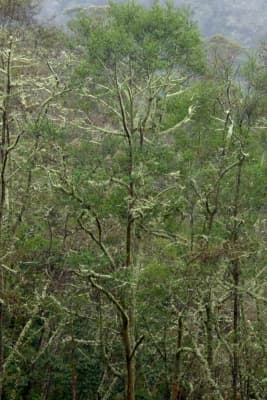
Alnus acuminata
Alnus acuminata
Safety & Hazards
None known
Cultivation Details
Alnus acuminata is a plant of higher elevations in the tropics, where it is generally found at elevations from 1,000 - 3,700 metres[1]. It grows best in areas where annual daytime temperatures are within the range 15 - 28°c, though it can tolerate 4 - 34°c[1]. Plants can withstand temperatures that dip briefly below 0°c[1]. It prefers a mean annual rainfall in the range 1,500 - 2,500mm, tolerating 1,000 - 3,500mm[1]. It is usually found in areas with a distinct dry season of 3 - 5 months[2]. Grows best in a sunny position, but can tolerate some shade[3, 1]. Prefers deep, well-drained soils with high content of organic matter[4]. Succeeds in shallow soils[4, 3]. Prefers a pH in the range 5.5 - 6.5, tolerating 4.5 - 7[1]. A fast-growing tree, it can reach a height of 25 metres in 10 years[1]. Plants can commence flowering when just 4 - 5 years old from seed[4]. Plants reproduce freely on exposed bare-soil surfaces[1]. Trees respond well to coppicing[5]. Grown in rotations of about 20 years, the optimum annual yield of wood for fuel and industrial use is 10 - 15 cubic metres per hectare[3, 1]. This species has a symbiotic relationship with certain soil bacteria, these bacteria form nodules on the roots and fix atmospheric nitrogen. Some of this nitrogen is utilized by the growing plant but some can also be used by other plants growing nearby[6].
Propagation
Seed - it has a short viability and should be sown as soon as it is ripe[4]. It requires 10 - 20 days of cold stratification at 5°c in moist sand[2]. Sow the treated seed in a nursery seedbed, only just covering it. Germination should commence within 13 days. The seedlings can be planted out into their permanent positions when they are 30 - 40cm tall, usually about 4 - 6 weeks after germination[2]. Cite as: Tropical Plants Database, Ken Fern. tropical.theferns.info. 2026-02-19. <tropical.theferns.info/viewtropical.php?id=Alnus+acuminata>
Pollinators
Wind
References
- [1]Ecocrop — http://ecocrop.fao.org/ecocrop/srv/en/home ↩︎Basic information on a wide range of useful plants, plus details of environmental needs where available.
- [2]Seed Leaflets — Various · Forest & Landscape. Denmark · http://en.sl.life.ku.dk/Publikationer/Udgivelser/PopulaerPublikationer.aspx?katid={D28373CC-6EF3-4EF8-B097-6D83FABF209E}&serieid={9F1C3DB1-6E7B-4CF1-AF53-F480B0CB40EF}&sort=title ↩︎A series of leaflets, jointly produced by the University of Copenhagen and the Royal Botanic Gardens at Kew, focussing on seed information for a number species, but also giving a lot of other information about each plant.
- [3]Timber Trees of Meso America. — UNEP · 2005 · http://www.unep-wcmc.org/forest/timber/workshops/reports/MA2005/Annex%202.pdf ↩︎A PDF document, published on the internet. Detailed reports on about 30 species of timber trees from Central America.
- [4]World Agroforesty Centre — http://www.worldagroforestry.org/ ↩︎An excellent online database of a huge range of trees giving very good information on each plant - its uses, ecology, identity, propagation, pests etc.
- [5]IUCN Red List of Threatened Species — http://www.iucnredlist.org/ ↩︎A list of plants under threat and facing possible extinction, usually with brief details of the threats and information on habitat.
- [6]The New RHS Dictionary of Gardening. 1992. — Huxley. A. · MacMillan Press · 1992 · ISBN 0-333-47494-5 ↩︎Excellent and very comprehensive, though it contains a number of silly mistakes. Readable yet also very detailed.
- [7]Flora of Guatemala — Standley P.C. & J. A. Steyermark · 1946 - 1976 · http://www.archive.org/ ↩︎A superb reference, though somewhat dated. Gives lots of plant uses as well as information on plant habit and habitat. The entire flora (13 volumes) can now be downloaded from http://www.archive.org/
- [8]Protabase - Plant Resources of Tropical Africa. — http://www.prota.org ↩︎An excellent on-line database with detailed information on over 3,200 species of useful plants of Africa.
- [9]Technical Information on 134 Species of Bolivian Woods — USDA Forest Service -- Forest Products Lab · USDA Forest Service · http://www2.fpl.fs.fed.us/publications/ ↩︎A PDF file, available for download. Exactly what the title says, brief and to the point.