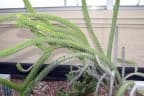
Alluaudia procera
Alluaudia procera
Safety & Hazards
None known
Cultivation Details
A plant of the arid and sub-arid lowland tropics where it is usually found at elevations below 450 metres. It is found in areas where the mean annual temperature is 23°c and the mean annual rainfall is 300 - 900mm, with 7 - 10 dry months each year[1]. The plant can tolerate temperatures down to around 0°c[2]. Requires a sunny position[3]. Prefers a position in light shade[2]. The plant is most commonly found in the wild on well-drained calcareous or alluvial soils, but also grows on gneissic, sandy and sandstone soils[1]. The growth of seedlings is slow; seedlings are on average only 2cm tall after 6 months, although some may reach 25cm after 14 months[1]. Young plants form a tangle of stems that last for several years after which a strong central stem develops. The basal stems then die out leaving a tree-like stem that branches higher up on the main trunk. Taking into consideration the climate and the dry, sandy soils in the area of distribution, established trees grow quite rapidly. Annual growth rates of 100 - 175cm in height, but only 2 - 3mm in bole diameter have been recorded, whereas annual wood volume increments in natural stands are 0.6 - 5.0 cubic metres/ha[1]. In plantations of 11 year old trees raised from cuttings, the largest specimens were 8 metres tall and 10 - 20cm in diameter, but most of them had a bad bole shape[1]. Crassulacean acid metabolism (CAM) has been found in this and other Alluaudia spp., fixing carbon dioxide during the night and having the stomata closed during the day. This can be considered an adaptation to arid conditions[1]. A dioecious species, both male and female forms need to be grown if fruit and seed are required[1].
Propagation
Seed - surface sow in a seed tray in a lightly shaded position and place the tray in a plastic bag until the first signs of germination are seen. The seed germinates best at a temperature of 22 - 25°c[3]. The germination rate is low; some tests showed a germination rate of only 0.1%. Some seeds germinate within 6 - 9 days, but germination may take up to 4 months[1]. Seedlings are susceptible to damping off and watering should be done carefully[1]. Prick out the seedlings as soon as they are large enough to handle (about 10mm tall) and grow on until large enough to plant out[3]. Seeds can be stored up to 6 months[1]. Cuttings of mature wood 20 - 30cm long. A basal temperature of around 25°c is best for rooting[3]. Propagation by cuttings is easy, and plants can also be successfully propagated by layering and root suckers[1]. Cite as: Tropical Plants Database, Ken Fern. tropical.theferns.info. 2026-02-19. <tropical.theferns.info/viewtropical.php?id=Alluaudia+procera>
Pollinators
Bees
References
- [1]Protabase - Plant Resources of Tropical Africa. — http://www.prota.org ↩︎An excellent on-line database with detailed information on over 3,200 species of useful plants of Africa.
- [2]Desert Tropicals — http://www.desert-tropicals.com/ ↩︎The main focus of the site is succulent plants, but it also contains information on a wide range of other species. Usually at least one good photograph, plus basic information about the plant and its cultivation.
- [3]The New RHS Dictionary of Gardening. 1992. — Huxley. A. · MacMillan Press · 1992 · ISBN 0-333-47494-5 ↩︎Excellent and very comprehensive, though it contains a number of silly mistakes. Readable yet also very detailed.
- [4]IUCN Red List of Threatened Species — http://www.iucnredlist.org/ ↩︎A list of plants under threat and facing possible extinction, usually with brief details of the threats and information on habitat.