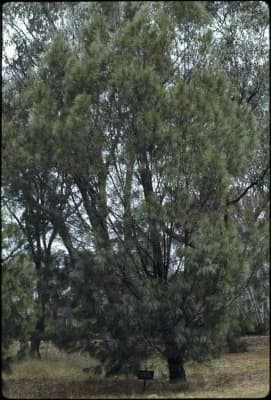
Allocasuarina littoralis
Allocasuarina littoralis
Safety & Hazards
None known
Cultivation Details
Allocasuarina littoralis has a very wide climatic tolerance, being found from the south of Tasmania to the tip of northern Queensland, from the temperate zone right through to the moist, lowland tropics. It succeeds in areas where the mean annual temperature is in the range 6 - 27°c, with the mean for the hottest month 19 - 30°c and the coolest month -1 - 16°c. It can tolerate temperatures down to about -5°c. It prefers a mean annual rainfall in the range 650 - 1,250mm[1]. Requires a well-drained moisture-retentive soil in full sun[2]. Tolerant of a wide range of soils from moderately heavy to sandy, it is often found growing in poor, dry, shallow soils in the wild[3, 2, 1]. Succeeds in very acid soils, but does not grow well in alkaline soils[1]. Plants are very tolerant of maritime exposure, though they often occur as coarse shrubs when growing in such situations[4, 1]. Established plants are drought tolerant[1]. A fast growing tree[1]. Plants do not coppice well, nor do they regenerate after fire[1]. The bark is rarely corky, in spite of its synonym (suberosa means corky)[5]. Plants in this species are usually dioecious, both male and female plants will usually need to be grown if seed is required[4]. This species has a symbiotic relationship with certain soil micro-organisms, these form nodules on the roots of the plants and fix atmospheric nitrogen. Some of this nitrogen is utilized by the growing plant but some can also be used by other plants growing nearby[6, 2].
Propagation
Seed - does not require pre-treatment[1]. Sow late winter to early summer in a greenhouse and only just cover the seed[7]. Germination starts in about 7 days at 25°c[1]. When they are large enough to handle, prick the seedlings out into individual pots and grow them on in a greenhouse for at least their first winter. Plant them out into their permanent positions in late spring or early summer, after the last expected frosts. Cuttings of half-ripe wood, mid summer in a frame[6, 2]. Cite as: Temperate Plants Database, Ken Fern. temperate.theferns.info. 2026-02-20. <temperate.theferns.info/plant/Allocasuarina+littoralis>
Pollinators
Data unavailable
References
- [1]Florabank Fact Sheets — http://www.florabank.org.au/lucid/key/Species%20Navigator/Media/Html/index.htm#D ↩︎An excellent on-line publication. At present their are 132 species in the list, giving lots of information on growing and using the plants, plus information on their climatic tolerances, distribution maps and photographs.
- [2]The New RHS Dictionary of Gardening. 1992. — Huxley. A. · MacMillan Press · 1992 · ISBN 0-333-47494-5 ↩︎Excellent and very comprehensive, though it contains a number of silly mistakes. Readable yet also very detailed.
- [3]A Field Guide to Australian Trees. — Holliday. I. and Hill. R. · Frederick Muller Ltd. · 1974 · ISBN 0-85179-627-3 ↩︎A well illustrated and very readable book, but it does not contain much information for the plant project.
- [4]Flora of Australia — http://www.anbg.gov.au/abrs/abif/flora/ ↩︎The full information from the Flora of Australia - on-line. An excellent resource.
- [5]RHS Dictionary of Plants plus Supplement. 1956 — F. Chittendon. · Oxford University Press · 1951 · ISBN - ↩︎Comprehensive listing of species and how to grow them. Somewhat outdated, it has been replaced in 1992 by a new dictionary (see [ 200 ]).
- [6]Australian Native Plants. — Wrigley. J. W. and Fagg. M. · Collins. (Australia) · 1988 · ISBN 0-7322-0021-0 ↩︎A lovely book, written in order to encourage Australian gardeners to grow their native plants. A little bit of information for the plant project.
- [7]Growing from Seed. Volume 3. — Bird. R. (Editor) · Thompson and Morgan. · 1989 · ISBN - ↩︎Very readable magazine with lots of information on propagation.
- [8]Flora of the Sydney Region — Carolin. R. & Tindale. M. · Reed. Australia. · 1993 · ISBN 0730104001 ↩︎Concise flora with little beyond an extensive key, species descriptions, very brief habitat description.
- [9]Dictionary of Economic Plants. — Uphof. J. C. Th. · Weinheim · 1959 · ISBN - ↩︎An excellent and very comprehensive guide but it only gives very short descriptions of the uses without any details of how to utilize the plants. Not for the casual reader.
- [10]The Useful Native Plants of Australia. — Maiden J.H. · Turner & Co.; London. · 1889 · http://www.biodiversitylibrary.org ↩︎Terse details of the uses of many Australian plants and other species naturalised, or at least growing, in Australia. It can be downloaded from the Internet.