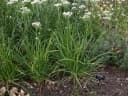
Allium tuberosum
Allium tuberosum
Safety & Hazards
Although no individual reports regarding this species have been seen, there have been cases of poisoning caused by the consumption, in very large quantities and by some mammals, of certain members of this genus. Dogs seem to be particularly susceptible[1].
Cultivation Details
Garlic chives succeeds in temperate and tropical climates[2]. High temperatures encourage bulb formation, but flower formation and seed production are only possible where the bulbs are subjected to low temperatures. In the tropics, flower and seed formation can therefore only occur at higher elevations, but generally the plants seldom produce seeds in the tropics. Outside the tropics dormancy is induced by short days and flowering by long days. Long days also favour bulb development. A cool period promotes early leaf production[3]. Plants tolerate 40 degrees of frost in Manchuria (the report does not say if this is fahrenheit or centigrade)[4]. Plants remain green until temperatures fall below 4 - 5°c, they come into new growth in spring when temperatures go above 2 - 3°c[4]. An easily grown plant[5], it prefers a sunny position, but tolerates some shade[6, 7, 5]. It tolerates most soils[8, 7], including clay[5, 4], growing best in a rich, moist but well-drained soil[6, 7]. Tolerant of dry soils, established plants also resist some drought[9]. Moist soil is required throughout the growing period, but excessive soil water and high humidity encourage diseases. The roots penetrate up to 50cm into the soil[4]. Prefers a pH in the range 6 - 6.8, tolerating 5.3 to 8.3[3]. Leaves may be harvested 70 - 120 days after planting and the same plant may produce for up to 20 - 30 years[3]. Often cultivated for its edible leaves and bulb in the Orient, there are many named varieties[2, 10]. There are two main types of cultivar, one is grown for its leaves and the other for its flowering stem[11, 4]. This species is being increasingly grown as a garden vegetable in Britain[PFAF]. The bulbs should be planted fairly deeply[6]. Members of this genus are rarely if ever troubled by browsing deer[12].
Propagation
Seed - sow spring in a cold frame. The seed has a fairly short viability and should not be used when more than 1 year old[4]. Prick out the seedlings into individual pots when they are large enough to handle - if you want to produce clumps more quickly then put three plants in each pot. Plant out in late summer if the plants have developed sufficiently, otherwise plant them out the following spring. Division in early spring. Very easy, the plants divide successfully at almost any time of the year. The divisions can be planted straight out into their permanent positions if required. Cite as: Temperate Plants Database, Ken Fern. temperate.theferns.info. 2026-02-20. <temperate.theferns.info/plant/Allium+tuberosum>
Pollinators
Bees, Insects
References
- [1]Poisonous Plants in Britain and their Effects on Animals and Man. — Cooper. M. and Johnson. A. · HMSO · 1984 · ISBN 0112425291 ↩︎Concentrates mainly on the effects of poisonous plants to livestock.
- [2]Bulbs — Phillips. R. and Rix. M. · Pan Books · 1989 · ISBN 0-330-30253-1 ↩︎Superbly illustrated, it gives brief details on cultivation and native habitat.
- [3]Ecocrop — http://ecocrop.fao.org/ecocrop/srv/en/home ↩︎Basic information on a wide range of useful plants, plus details of environmental needs where available.
- [4]Oriental Vegetables — Larkcom J. · John Murray · 1991 · ISBN 0-7195-4781-4 ↩︎Well written and very informative.
- [5]Alliums. The Ornamental Onions. — Davies. D. · Batsford · 1992 · ISBN 0-7134-7030-5 ↩︎Covers about 200 species of Alliums. A very short section on their uses, good details of their cultivation needs.
- [6]RHS Dictionary of Plants plus Supplement. 1956 — F. Chittendon. · Oxford University Press · 1951 · ISBN - ↩︎Comprehensive listing of species and how to grow them. Somewhat outdated, it has been replaced in 1992 by a new dictionary (see [ 200 ]).
- [7]The Garden. Volume 112. — RHS. · Royal Horticultural Society · 1987 · ISBN - ↩︎Snippets of information from the magazine of the RHS. In particular, there are articles on plants that are resistant to honey fungus, oriental vegetables, Cimicifuga spp, Passiflora species and Cucurbits.
- [8]Salads all the Year Round. — Larkcom. J. · Hamlyn · 1980 ↩︎A good and comprehensive guide to temperate salad plants, with full organic details of cultivation.
- [9]The Dry Garden. — Chatto. B. · Dent · 1982 · ISBN 0460045512 ↩︎A good list of drought resistant plants with details on how to grow them.
- [10]Cornucopia - A Source Book of Edible Plants. — Facciola. S. · Kampong Publications · 1990 · ISBN 0-9628087-0-9 ↩︎Excellent. Contains a very wide range of conventional and unconventional food plants (including tropical) and where they can be obtained (mainly N. American nurseries but also research institutes and a lot of other nurseries from around the world.
- [11]The New RHS Dictionary of Gardening. 1992. — Huxley. A. · MacMillan Press · 1992 · ISBN 0-333-47494-5 ↩︎Excellent and very comprehensive, though it contains a number of silly mistakes. Readable yet also very detailed.
- [12]Perennial Garden Plants — Thomas. G. S. · J. M. Dent & Sons, London. · 1990 · ISBN 0 460 86048 8 ↩︎A concise guide to a wide range of perennials. Lots of cultivation guides, very little on plant uses.
- [13]Flora of China — Missouri Botanical Garden Press; St. Louis. · 1994 · http://flora.huh.harvard.edu/china/ ↩︎An excellent, comprehensive resource in 25 volumes. In addition to the botanical information the flora also gives basic information on habitat and some uses. An on-line version is also available.
- [14]A partial revision of Allium (Amaryllidaceae) in Korea and north-eastern China — Choi H.J. & Oh B.U. · 2011 ↩︎
- [15]Flora of N. America — http://flora.huh.harvard.edu/fna/ ↩︎An on-line version of the flora with an excellent description of the plant including a brief mention of plant uses.
- [16]Edible Ornamental Garden. — Bryan. J. and Castle. C. · Pitman Publishing · 1976 · ISBN 0-273-00098-5 ↩︎A small book with interesting ideas for edible plants in the ornamental garden.
- [17]Dictionary of Economic Plants. — Uphof. J. C. Th. · Weinheim · 1959 · ISBN - ↩︎An excellent and very comprehensive guide but it only gives very short descriptions of the uses without any details of how to utilize the plants. Not for the casual reader.
- [18]Encyclopaedia of Herbs and their Uses. — Bown. D. · Dorling Kindersley, London. · 1995 · ISBN 0-7513-020-31 ↩︎A very well presented and informative book on herbs from around the globe. Plenty in it for both the casual reader and the serious student. Just one main quibble is the silly way of having two separate entries for each plant.
- [19]Famine Foods listed in the Chiu-Huang Pen-ts'ao. — Reid. B. E. · Southern Materials Centre; Taipei · 1977 · ISBN - ↩︎A translation of an ancient Chinese book on edible wild foods. Fascinating.
- [20]A Dictionary of Plants Used by Man. — Usher. G. · Constable · 1974 · ISBN 0094579202 ↩︎Forget the sexist title, this is one of the best books on the subject. Lists a very extensive range of useful plants from around the world with very brief details of the uses. Not for the casual reader.
- [21]Atlas of Medicinal Plants. — Kariyone. T. · Nihon Rinshosha; Osaka · 1973 ↩︎A good Japanese herbal.
- [22]Medicinal Plants of China — Duke. J. A. and Ayensu. E. S. · Reference Publications, Inc. · 1985 · ISBN 0-917256-20-4 ↩︎Details of over 1,200 medicinal plants of China and brief details of their uses. Often includes an analysis, or at least a list of constituents. Heavy going if you are not into the subject.
- [23]Glossary of Indian Medicinal Plants (Including the Supplement). — Chopra. R. N., Nayar. S. L. and Chopra. I. C. · Council of Scientific and Industrial Research, New Delhi. · 1986 · ISBN - ↩︎Very terse details of medicinal uses of plants with a wide range of references and details of research into the plants chemistry. Not for the casual reader.
- [24]Companion Planting for Successful Gardening. — Riotte. L. · Garden Way, Vermont, USA. · 1978 · ISBN 0-88266-064-0 ↩︎Fairly good.
- [PFAF]Plants for a Future — pfaf.org ↩︎