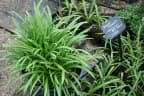
Allium hookeri
Allium hookeri
Safety & Hazards
Although no individual reports regarding this species have been seen, there have been cases of poisoning caused by the consumption, in large quantities and by some mammals, of certain members of this genus. Dogs seem to be particularly susceptible[1].
Cultivation Details
Allium hookeri grows in the subtropical and tropical regions of China, India, Bhutan, Myanmar and Sri Lanka. It is found at elevations up to 4,200 metres and can be grown outside at least in areas of the temperate zone with mild winters. Prefers a sunny position in a light well-drained soil[2]. The bulbs should be planted fairly deeply[2]. Most members of this genus are intolerant of competition from other growing plants[3]. Cultivated forms of this plant usually do not produce fertile seed[4].
Propagation
Seed - sow spring in a cold frame. Prick out the seedlings into individual pots when they are large enough to handle - if you want to produce clumps more quickly then put three plants in each pot. Grow them on in the greenhouse for at least their first winter and plant them out into their permanent positions in spring once they are growing vigorously and are large enough. Division in spring. The plants divide successfully at any time in the growing season, pot up the divisions in a cold frame or greenhouse until they are growing well and then plant them out into their permanent positions. Cite as: Temperate Plants Database, Ken Fern. temperate.theferns.info. 2026-02-20. <temperate.theferns.info/plant/Allium+hookeri>
Pollinators
Bees, Insects
References
- [1]Poisonous Plants in Britain and their Effects on Animals and Man. — Cooper. M. and Johnson. A. · HMSO · 1984 · ISBN 0112425291 ↩︎Concentrates mainly on the effects of poisonous plants to livestock.
- [2]RHS Dictionary of Plants plus Supplement. 1956 — F. Chittendon. · Oxford University Press · 1951 · ISBN - ↩︎Comprehensive listing of species and how to grow them. Somewhat outdated, it has been replaced in 1992 by a new dictionary (see [ 200 ]).
- [3]Alliums. The Ornamental Onions. — Davies. D. · Batsford · 1992 · ISBN 0-7134-7030-5 ↩︎Covers about 200 species of Alliums. A very short section on their uses, good details of their cultivation needs.
- [4]Mansfeld's Database of Agricultural and Horticultural Plants — http://mansfeld.ipk-gatersleben.de/pls/htmldb_pgrc/f?p=185:3:4292127278597336 ↩︎Terse details of a huge range of useful plants.
- [5]Flora of China — Missouri Botanical Garden Press; St. Louis. · 1994 · http://flora.huh.harvard.edu/china/ ↩︎An excellent, comprehensive resource in 25 volumes. In addition to the botanical information the flora also gives basic information on habitat and some uses. An on-line version is also available.
- [6]Flowers of India — http://www.flowersofindia.net/ ↩︎A wed site of native Indian plants, plus cultivated and naturalized species. It has good quality photos and terse details on more than 3,000 species and cultivars.
- [7]Ethnobotanical Notes on Allium Species of Arunachal Pradesh, India — Ashalata Devi; K. Rakshit; B. Sarania et al · 2014 ↩︎Information on the traditional uses of nine Allium species from Arunachal Pradesh
- [8]Plants for Human Consumption. — Kunkel. G. · Koeltz Scientific Books · 1984 · ISBN 3874292169 ↩︎An excellent book for the dedicated. A comprehensive listing of Latin names with a brief list of edible parts.
- [9]Companion Planting for Successful Gardening. — Riotte. L. · Garden Way, Vermont, USA. · 1978 · ISBN 0-88266-064-0 ↩︎Fairly good.
- [PFAF]Plants for a Future — pfaf.org ↩︎