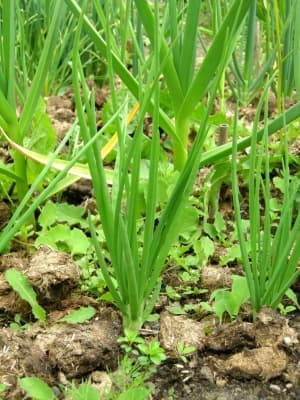
Allium cepa aggregatum
Allium cepa aggregatum
Safety & Hazards
There have been cases of poisoning caused by the consumption, in large quantities and by some mammals, of this plant. Dogs seem to be particularly susceptible[1].
Cultivation Details
Allium cepa aggregatum (the shallot) is a commonly grown vegetable, mainly in the temperate zone but it also succeeds in many areas of the tropics. Prefers a sunny sheltered position in a light well-drained fertile soil[2] but tolerates most soils. Does not grow well on heavy clays[3]. Prefers a pH in the range 6 to 7[3]. Tolerates a pH in the range 4.5 to 8.3. The shallot is a genuinely perennial form of Allium cepa that is widely grown in temperate and tropical areas for its edible bulbs[3]. These are milder but smaller than the onion. There are several named forms[3]. The plant is easier to grow than onions, matures faster and keeps better[3], though yields are lower. The potato onion was at one time fairly widely grown as a vegetable, but it has now fallen into virtual disuse[4]. The bulb grows deeper in the soilthan the shallot, and divides to produce a number of underground bulbs each year in much the same way as shallots (which grow nearer the surface). Large bulbs divide to form 5 - 15 bulbs whilst smaller bulbs grow into one large bulb[5]. There are some named forms available[6]. According to one report, the bulbs should be planted fairly deeply[2], whilst another report says that they should be planted just below soil level[7]. Plants are very tolerant of high temperatures up to 30°c and bulbing only occurs at temperatures above 20°c[3]. Plants rarely produce viable seed in temperate areas, they are usually propagated by means of their bulbs, each one dividing up in the growing season to produce from 2 to more than 12 new bulbs[3]. Bulbs can become infected with virus, it is important to only plant clean stock[3]. Onions are closely related to Allium oschanini. O.Fedsch., a wild species found in C. Asia[8].
Propagation
Seed - sow spring in a cold frame. Seed is seldom produced by this plant[7]. Division in late summer. Harvest the bulbs as the foliage dies down and store them in a cool place. In areas with mild winters the bulbs are traditionally replanted on the shortest day of the year, but in colder areas it is best to wait until late winter or even early spring[7]. Plant the bulbs only just below the soil surface[7]. Plant out bulbs in late winter or very early spring. Plant firmly to half the bulbs depth and protect from birds until the bulbs have rooted[3]. (Birds seem to have a fascination for pulling the bulbs out of the ground and then leaving them lying on the surface[PFAF].) Traditionally, bulbs were planted on the shortest day and harvested on the longest. Smaller bulbs are less likely to bolt as a result of exposure to cold conditions[3]. Cite as: Temperate Plants Database, Ken Fern. temperate.theferns.info. 2026-02-20. <temperate.theferns.info/plant/Allium+cepa+aggregatum>
Pollinators
Bees, Insects
References
- [1]Poisonous Plants in Britain and their Effects on Animals and Man. — Cooper. M. and Johnson. A. · HMSO · 1984 · ISBN 0112425291 ↩︎Concentrates mainly on the effects of poisonous plants to livestock.
- [2]RHS Dictionary of Plants plus Supplement. 1956 — F. Chittendon. · Oxford University Press · 1951 · ISBN - ↩︎Comprehensive listing of species and how to grow them. Somewhat outdated, it has been replaced in 1992 by a new dictionary (see [ 200 ]).
- [3]The New RHS Dictionary of Gardening. 1992. — Huxley. A. · MacMillan Press · 1992 · ISBN 0-333-47494-5 ↩︎Excellent and very comprehensive, though it contains a number of silly mistakes. Readable yet also very detailed.
- [4]New Vegetable Growers Handbook. — Simons. · Penguin · 1977 · ISBN 0-14-046-050-0 ↩︎A good guide to growing vegetables in temperate areas, not entirely organic.
- [5]Wonder Crops. 1987. — Natural Food Institute, ↩︎Fascinating reading, this is an annual publication. Some reports do seem somewhat exaggerated though.
- [6]Cornucopia - A Source Book of Edible Plants. — Facciola. S. · Kampong Publications · 1990 · ISBN 0-9628087-0-9 ↩︎Excellent. Contains a very wide range of conventional and unconventional food plants (including tropical) and where they can be obtained (mainly N. American nurseries but also research institutes and a lot of other nurseries from around the world.
- [7]A Modern Herbal. — Grieve. · Penguin · 1984 · ISBN 0-14-046-440-9 ↩︎Not so modern (1930's?) but lots of information, mainly temperate plants.
- [8]Alliums. The Ornamental Onions. — Davies. D. · Batsford · 1992 · ISBN 0-7134-7030-5 ↩︎Covers about 200 species of Alliums. A very short section on their uses, good details of their cultivation needs.
- [9]Flora of China — Missouri Botanical Garden Press; St. Louis. · 1994 · http://flora.huh.harvard.edu/china/ ↩︎An excellent, comprehensive resource in 25 volumes. In addition to the botanical information the flora also gives basic information on habitat and some uses. An on-line version is also available.
- [10]Rare Vegetables for Garden and Table. — Organ. J. · Faber · 1960 · ISBN - ↩︎Unusual vegetables that can be grown outdoors in Britain. A good guide.
- [11]Sturtevant's Edible Plants of the World. — Hedrick. U. P. · Dover Publications · 1972 · ISBN 0-486-20459-6 ↩︎Lots of entries, quite a lot of information in most entries and references.
- [12]The Gardener's Assistant. — Thompson. B. · Blackie and Son. · 1878 · ISBN - ↩︎Excellent general but extensive guide to gardening practices in the 19th century. A very good section on fruits and vegetables with many little known species.
- [13]Encyclopaedia of Medicinal Plants. — Chiej. R. · MacDonald · 1984 · ISBN 0-356-10541-5 ↩︎Covers plants growing in Europe. Also gives other interesting information on the plants. Good photographs.
- [14]The Herb Book. — Lust. J. · Bantam books · 1983 · ISBN 0-553-23827-2 ↩︎Lots of information tightly crammed into a fairly small book.
- [15]The Encyclopedia of Medicinal Plants — Chevallier. A. · Dorling Kindersley. London · 1996 · ISBN 9-780751-303148 ↩︎An excellent guide to over 500 of the more well known medicinal herbs from around the world.
- [16]A - Z of Companion Planting. — Allardice.P. · Cassell Publishers Ltd. · 1993 · ISBN 0-304-34324-2 ↩︎A well produced and very readable book.
- [17]Alternative Enterprises for Agriculture in the UK. — Carruthers. S. P. (Editor) · Centre for Agricultural Strategy, Univ. of Reading · 1986 · ISBN 0704909820 ↩︎Some suggested alternative commercial crops for Britain. Readable. Produced by a University study group.
- [18]Nature's Colors - Dyes from Plants. — Grae. I. · MacMillan Publishing Co. New York. · 1974 · ISBN 0-02-544950-8 ↩︎A very good and readable book on dyeing.
- [PFAF]Plants for a Future — pfaf.org ↩︎