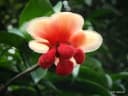
Allanblackia stuhlmannii
Allanblackia stuhlmannii
Safety & Hazards
None known
Cultivation Details
A tree of the tropics, average annual rainfall in its habitat is 1,100 - 2,400mm with more than 180 rainy days a year[1]. The mean annual temperature is 18°c, maximum temperatures range from 25°c to 35°c whilst minima are occasionally as low as 3°c[1]. Grows best in a sunny position[2].Trees grow naturally on mostly acidic clay soils derived from granite, gneiss or siliceous rock[1]. Prefers a well-drained soil[2]. Under natural conditions, trees first flower when about 12 years old. Flowering is during the short rainy season in November - February and the fruits take more than 1 year to develop and mature[1]. A mature tree may yield up to 150 fruits or up to 50 kg fat per year[1]. The trees are fire-tolerant[1]. The fat from the seeds of Allanblackia stuhlmannii is very similar in composition to that of Allanblackia parviflora and Allanblackia floribunda[1]. A dioecious species, both male and female forms must be grown if seed is required[1]. Female trees are often retained when clearing land for agriculture, but planting is still rare. It is estimated that 1 male tree per 10 female trees is needed to ensure adequate pollination[1]. ICRAF, Kenya, is studying possibilities to domesticate this species and develop appropriate management techniques. A complete seed marketing chain is also being developed[1]. Selection of high-yielding trees for vegetative reproduction has started in Tanzania[1].
Propagation
Seed. Well-matured fruits are kept for about 2 weeks to allow the pulp to become soft and to make extraction of the seed easy. Fruits may be kept for up to 3 months if covered with banana leaves. Clean seeds are placed in a nursery where they take about 3 months to start to germinate, but germination may take more than 7 months to start and another 18 months to complete[1]. After germination the seedlings are transferred to polythene tubes filled with soil. Mycorrhizae are necessary for successful growth of the seedlings and it is therefore important to add soil from around the base of mother trees to the substrate[1]. Cuttings are placed a few cm deep in soil at a 45° angle in polythene tubes with at least 1 node above the substrate. Cuttings strike root in 8 - 12 weeks, after which sprouted and rooted cuttings are transferred to polybags[1]. Methods of layering and budding are being developed. Initial tests with wildlings have shown good survival rates both with farmers and in experiments[1]. Cite as: Tropical Plants Database, Ken Fern. tropical.theferns.info. 2026-02-19. <tropical.theferns.info/viewtropical.php?id=Allanblackia+stuhlmannii>
Pollinators
Insects, Birds, Bats
References
- [1]Protabase - Plant Resources of Tropical Africa. — http://www.prota.org ↩︎An excellent on-line database with detailed information on over 3,200 species of useful plants of Africa.
- [2]World Agroforesty Centre — http://www.worldagroforestry.org/ ↩︎An excellent online database of a huge range of trees giving very good information on each plant - its uses, ecology, identity, propagation, pests etc.
- [3]Edible Wild Plants of Tanzania — Ruffo, C.K.: Birnie, A. & Tengnas, B. · Regional Land Management Unit; Nairobi. · 2002 · ISBN 9966-896-60-0 ↩︎A very well presented, simple guide to growing and utilizing wild food plants in Tanzania, with line drawings of each plant, a description, habitat and range, non-food as well as food uses, plus basic information on growing the plants.
- [4]Dictionary of Economic Plants. — Uphof. J. C. Th. · Weinheim · 1959 · ISBN - ↩︎An excellent and very comprehensive guide but it only gives very short descriptions of the uses without any details of how to utilize the plants. Not for the casual reader.