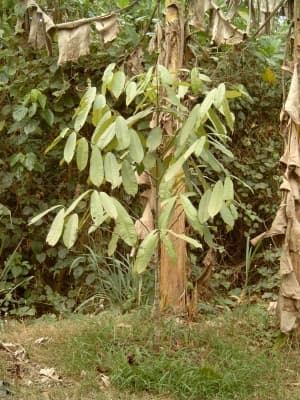
Allanblackia parviflora
Allanblackia parviflora
Safety & Hazards
None known
Cultivation Details
Found in the wild on strongly leached, acid soils with a pH in the range 3.8 - 4.1[1]. The tree has brittle branches and requires a position sheltered from strong winds[1]. The degree of maturity of fruits on the tree can not be estimated; therefore mature fruits are left to drop to the ground and are then collected[1]. The fat from the seeds of Allanblackia parviflora is very similar in composition to that of Allanblackia floribunda and Allanblackia stuhlmannii[1].
Propagation
Seed - germination can take 24 - 30 months and germination rates are very low[1]. Keeping the fruits for a few months on damp sites (covered with banana leaves and buried partially) and scarification of the seedcoat improve germination rates only slightly[1]. Methods of propagation by cuttings and grafting are being developed[1]. Cite as: Tropical Plants Database, Ken Fern. tropical.theferns.info. 2026-02-19. <tropical.theferns.info/viewtropical.php?id=Allanblackia+parviflora>
Pollinators
Data unavailable
References
- [1]Protabase - Plant Resources of Tropical Africa. — http://www.prota.org ↩︎An excellent on-line database with detailed information on over 3,200 species of useful plants of Africa.
- [2]African Flowering Plants Database — Conservatoire et Jardin Botaniques. · http://www.ville-ge.ch/musinfo/bd/cjb/africa/recherche.php ↩︎Contains information on over 150,000 plant names (including synonyms) giving a description and habitat, plus a distribution map.
- [3]The Useful Plants of West Tropical Africa. — Burkil. H. M. · Royal Botanic Gardens; Kew. · 1985 - 2004 ↩︎Brief descriptions and details of the uses of over 4,000 plants. A superb, if terse, resource, it is also available electronically on the Web - see http://www.aluka.org/
- [4]World Agroforesty Centre — http://www.worldagroforestry.org/ ↩︎An excellent online database of a huge range of trees giving very good information on each plant - its uses, ecology, identity, propagation, pests etc.
- [PFAF]Plants for a Future — pfaf.org ↩︎