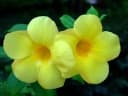
Allamanda cathartica
Allamanda cathartica
Safety & Hazards
The plant contains a poisonous, milky sap - all parts of the plant are considered to be toxic[1].
Cultivation Details
A plant of moist, tropical lowland regions, where it can be found at elevations up to 700 metres. It is found growing in Puerto Rico in areas where the mean annual rainfall is in the range 1,000 - 2,800mm, though may be tolerant of a greater range than this. Plants are intolerant of frosts, being killed by temperatures of -1°c[2]. Prefers a position in full sun, but tolerant of light shade[2]. Grows well in most soils in the tropics and sub-tropics, preferring well drained, moist, sandy soils rich in organic matter, but it becomes chlorotic in very alkaline conditions and is intolerant of saline soils[1, 2]. Established plants are drought tolerant[3]. Widely grown as an ornamental, the plant has escaped from cultivation in many areas and become naturalized[1]. It is classified as 'invasive' in many areas. Because seed is rarely produced by cultivated varieties, naturalization is usually by vegetative means. In Puerto Rico, for example, where the species has been planted widely, it persists tenaciously, and spreads by layering as the vines extend. In addition, trimmings dumped in vacant lots and wildlands root readily and start new colonies[2]. Simply cutting back the plant does not kill it - either all the roots have to be removed, or all new growth must be cut back to ground level as soon as it is seen until the plant eventually dies of exhaustion[2]. A fast-growing plant with stems extending by 1 - 3 metres a year[1, 2]. The plant responds very well to trimming and pruning, resprouting readily even from old wood[2]. The plant usually flowers and produces fruit all year round[1]. A dioecious species, both male and female forms need to be grown if fruit and seed are required.
Propagation
Seed - Cuttings root easily[2]. Cite as: Tropical Plants Database, Ken Fern. tropical.theferns.info. 2026-02-19. <tropical.theferns.info/viewtropical.php?id=Allamanda+cathartica>
Pollinators
Data unavailable
References
- [1]Dominica Botanic Gardens — http://www.da-academy.org/trees_shrubs.html ↩︎An on-line resource, providing top quality pictures and some basic information on various plants being grown at the Botanic Gardens, often including uses and habitat.
- [2]Wildland Shrubs of the United States and its Territories: Thamnic Descriptions — Francis J.K. (Editor) · USDA; Forest Service International Institute of Tropical Forestr · 2000 · http://www.fs.fed.us/global/iitf/wildland_shrubs.htm ↩︎An excellent series of papers, in PDF format, from various authors giving quite detailed information on a range of shrubs growing in the United States and its Territories. It can be downloaded from the Internet.
- [3]Institute of Food and Agricultural Sciences, University of Florida — University of Florida · http://hort.ifas.ufl.edu/shrubs/ ↩︎PDF fact sheets on over 500 shrubs.
- [4]Philippine Medicinal Plants — http://www.stuartxchange.org/CompleteList.html ↩︎A lovely site, giving brief details on the medicinal uses of several hundred (over 400 at the last count) plants in the Philippines, plus a picture of each plant.