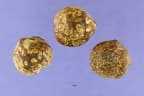
Aleurites moluccanus
Aleurites moluccanus
Safety & Hazards
The fresh seed contains a principle resembling croton oil and should not be eaten[1]. Thorough drying destroys this principle[1]. The seeds contain cyanide, which is largely destroyed by thorough drying or cooking. However, some strains of the tree contain much higher levels of toxins than other strains[2]. The leaves are toxic[3].
Cultivation Details
The tree thrives in moist tropical regions, ranging from subtropical dry to wet through tropical very dry to wet forest life zones. It grows best at altitudes below 1,200 metres with a mean annual temperature in the range 18 - 28°c, and a mean annual rainfall of 650 - 4,300mm[4]. Plants can tolerate short-lived frosts with temperatures occasionally falling as low as -4°c[2]. Requires a sunny position[5]. Succeeds in a wide range of soils so long as they are well-drained[6]. Plants prefer a pH in the range 5 - 8[4]. Tolerant of strong winds and some salt spray[6]. Some caution should be employed before introducing this tree into new areas since it can be very invasive[7]. Growth is moderately fast, up to 1.5 metres per year in height under favourable conditions. In the Philippines trees reached a height of 12.5 metres with a stem diameter of 15cm 8 years after planting[6]. The tree first flowers when it is about 4 years old. Flowering can occur year-round, and flowers and fruits of all stages of development may be present on a tree. The fruits need 3 - 4 months to develop and mature[6]. Once established, trees require little to no attention. They can bear 2 heavy crops each year, harvested when mature[4]. In plantations nut yields are estimated at 5 - 20 tonnes per hectare, with each tree producing 30 - 80 kg[4]. Oil production varies from 15 to 20% of nut weight[4]. Trees coppice when young and respond to pollarding when old[4].
Propagation
Seed - The seeds are very hard-shelled, and untreated seeds have been known to stay in a seedbed for as long as 38-150 days before germination[4]. The most satisfactory method of treatment is to place a single layer of seeds on the ground and cover them with dried leaves or grass. The grass is then burned. Immediately after burning and while seeds are still hot, they are thrown into cold water, which results in the cracking of the hard shells. The results of this kind of treatment showed an average germination of more than 30%[4]. For even faster germination, the seed can be cracked[4]. Kernels adhere to sides of the shell and are difficult to separate[4] Cuttings. Cite as: Tropical Plants Database, Ken Fern. tropical.theferns.info. 2026-02-19. <tropical.theferns.info/viewtropical.php?id=Aleurites+moluccanus>
Pollinators
Bees
References
- [1]Nuts. — Howes. F. N. · Faber · 1948 · ISBN - ↩︎Rather old but still a masterpiece. Has sections on tropical and temperate plants with edible nuts plus a section on nut plants in Britain. Very readable.
- [2]Trade Winds Fruit — http://www.tradewindsfruit.com/index.htm ↩︎The on-line catalogue of a company selling seeds. Gives descriptions, photos and uses of a very wide range of fruit and other food-producing plants plus ornamentals.
- [3]Medicinal Plants in the South Pacific — WHO Regional Publications, Manilla. · 1998 · ISBN 92-9061-118-9 ↩︎Excellent guide to 102 medicinal herbs of the Pacific Islands, with photographs of each plant and details of their constituents, biological activities and traditional uses. A description of each plant, together with habitat and distribution is given.
- [4]World Agroforesty Centre — http://www.worldagroforestry.org/ ↩︎An excellent online database of a huge range of trees giving very good information on each plant - its uses, ecology, identity, propagation, pests etc.
- [5]Trees of Laos and Vietnam - A Field Guide to 100 species. — Hoang Van Sam; Khamseng Nanthavong; Kessler P.J.A. · Blumea · 2004 ↩︎A detailed guide, with excellent line-drawings, to 100 of the more important trees of Laos and Vietnam. A very good work, giving lots of information about each plant. Originally published in the journal Blumea, it is available as a PDF on the Interne
- [6]Protabase - Plant Resources of Tropical Africa. — http://www.prota.org ↩︎An excellent on-line database with detailed information on over 3,200 species of useful plants of Africa.
- [7]Tropical and Subtropical Trees - A Worldwide Encyclopaedic Guide. — Barwick. M. · Thames & Hudson, London · 2004 · ISBN 0-500-51181-0 ↩︎A superb book, very concise and well written, giving a wealth of information on 400 or more species including descriptions, habitat, cultivation details and plant uses. A wealth of colour photographs bring each plant vividly to life.
- [8]Plant Resources of Southeast Asia — http://proseanet.org/ ↩︎Lots of information on the uses of the plants of SE Asia.
- [9]Cornucopia II — Facciola. S. · Kampong Publications, California. · 1998 · ISBN 0-9628087-2-5 ↩︎The second edition of an excellent guide to the edible uses of plants, though it does not give any details of cultivation etc.