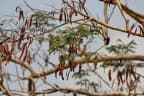
Albizia procera
Albizia procera
Safety & Hazards
The seeds contain proceranin A, which is toxic to mice and rats when administered parenterally and orally; the interperitoneal LD50 for mice is 15 mg/kg body weight. Hydrocyanic acid has been identified as occurring in the tree[1].
Cultivation Details
Succeeds in tropical, subtropical and warm temperate zones at elevations from sea level to around 1,500 metres[2, 1]. It tolerates areas with a mean annual temperature ranging from a minimum of 1 - 18 up to 37 - 46°c and a mean annual rainfall of 100 - 5,000 mm[1]. Plants are susceptible to frost[1]. Grows well on fertile soils, but is also able to succeed on dry, sandy, stony and shallow soils[1]. Trees can succeed in both moderately saline and alkaline soils[1]. Established plants are drought tolerant[1]. Adult plants succeed in full sun and light shade, though young trees require more shade[1]. Succeeds in areas with a pronounced dry season[1]. Because of its aggressive growth, the tree is a potential weed[1]. This is particularly true in the Caribbean, where it grows faster than many native species[1]. If the area is not burned, A. Procera will colonize alang-alang (Imperata cylindrica) grassland[1]. Trees can attain a mean annual increment in diameter of 1 - 4 cm; attaining a dbh of 40-60 cm in 30 years[1]. Spacing of 2-3 x 0.5 m in pure stands results in canopy closure in about 3 years[1]. Due to the light crown, regular weeding and control of the undergrowth are required. Therefore the tree is often mixed with other species[303. Mixed planting and pruning in open stands can improve stem form and give a bushy crown[1]. Seedlings, saplings and larger trees all coppice vigorously when damaged[1]. Farmers sometimes leave the trees untouched when clearing land for crops, since the trees cast only a light shade, add nitrogen to the soil and conserve water[1]. They also function as a cash reserve since the wood is sought after by local wood carvers[1]. This species has a symbiotic relationship with certain soil bacteria, these bacteria form nodules on the roots and fix atmospheric nitrogen. Some of this nitrogen is utilized by the growing plant but some can also be used by other plants growing nearby[2]. The application of phosphorus fertilizer can improve nodulation and nitrogen fixation, particularly on infertile soils[1].
Propagation
Fresh seed has a rapid germination rate of 90-100%[1]. Seeds that have been stored for 4 - 5 months or longer should be soaked in boiling water for 5 seconds, then removed from direct heat and soaked in cool water overnight, and then sown immediately[1]. This doubles the germination rate[1]. Manual scarification of the seed coat before boiling seeds could also assist germination[1]. Direct sowing in the field has proved more successful than planting out from a nursery, provided there is an abundance of soil moisture and that weeding and loosening of the soil are done regularly. Line sowing to facilitate weeding has given great success. Healthy seedlings produce a thick, long taproot[1]. Seed storage behaviour is orthodox. Clean seed can be stored at room temperature for 10 months with minimal loss of viability. However, germination can drop to below 50% after storage[1]. Seeds survive 10 years or more at room temperature. Viability is maintained for more than 3 years in hermetic storage at room temperature with 13 + or - 2% mc[1]. Plants can be propagated quite successfully by stem or root cuttings provided that this is not done during the peak of the rainy or the dry season[1]. Vegetative propagation also occurs through layering[1]. Root suckers are readily produced when roots are exposed[1]. Cite as: Tropical Plants Database, Ken Fern. tropical.theferns.info. 2026-02-19. <tropical.theferns.info/viewtropical.php?id=Albizia+procera>
Pollinators
Insects
References
- [1]World Agroforesty Centre — http://www.worldagroforestry.org/ ↩︎An excellent online database of a huge range of trees giving very good information on each plant - its uses, ecology, identity, propagation, pests etc.
- [2]The New RHS Dictionary of Gardening. 1992. — Huxley. A. · MacMillan Press · 1992 · ISBN 0-333-47494-5 ↩︎Excellent and very comprehensive, though it contains a number of silly mistakes. Readable yet also very detailed.
- [3]Trees of Laos and Vietnam - A Field Guide to 100 species. — Hoang Van Sam; Khamseng Nanthavong; Kessler P.J.A. · Blumea · 2004 ↩︎A detailed guide, with excellent line-drawings, to 100 of the more important trees of Laos and Vietnam. A very good work, giving lots of information about each plant. Originally published in the journal Blumea, it is available as a PDF on the Interne