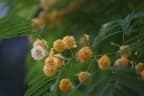
Albizia odoratissima
Albizia odoratissima
Safety & Hazards
The bark is used as a fish poison[1].
Cultivation Details
Black siris can be grown in the tropics and subtropics at elevations from sea level to 1,500 metres, where it tolerates a wide range of temperatures and rainfall[2]. It grows best in areas where the mean annual temperature is in the range 22 - 33°c, though in its natural range the maximum shade temperature varies from 37 - 50°c and the minimum from 0 - 15°c[2]. It prefers a mean annual rainfall between 650 - 3,000 mm and normally experiences a 4 - 5 month dry season[2]. Seedlings and young trees are susceptible to frost[2]. Grows best in fertile soils[2]. Requires a well-drained soil and a position in full sun or light shade[2]. Young trees require some shade[2]. Established trees are drought resistant[2]. Prefers a pH in the range 5.5 - 6.5, tolerating 4.5 - 7.5[3]. The tree grows sporadically in both dry and moist deciduous forest zones. Under tropical conditions the species is not gregarious. It tolerates hot humid conditions but not waterlogging. On good sites 5-year-old trees can be 5 metres in height and the trunk 14 cm in diameter[2]. A mean annual diameter increment of 1.3 cm has been recorded for this species[2]. Trees coppice well, new shoots reaching a height of 3 metres in 2 years after being cut down[2]. Plants are susceptible to fire, resistant to weed competition and drought[2]. They regenerate naturally in sheltered areas with good soil[2]. This species has a symbiotic relationship with certain soil bacteria, these bacteria form nodules on the roots and fix atmospheric nitrogen. Some of this nitrogen is utilized by the growing plant but some can also be used by other plants growing nearby[4].
Propagation
Seed - to break dormancy the seed can be soaked in cool water for 1 hour, in 80 deg C water for two minutes, or in boiling water for 30 seconds[2]. Removed from the water, moist seed is stored overnight and then sown the following morning[2]. Seedlings emerge within a week. Fresh seed may have a germination rate of 99%[2]. Germination of year-old seed decreases to 55-65%[2]. Sow 2 - 3 seeds in each container at a depth of 5 - 20 mm and cover with a thin layer of sand[2]. Cite as: Tropical Plants Database, Ken Fern. tropical.theferns.info. 2026-02-19. <tropical.theferns.info/viewtropical.php?id=Albizia+odoratissima>
Pollinators
Insects
References
- [1]A Field Guide to Forest Trees of Northern Thailand — Gardener S.; Sidisunthorn P.; Anusarnsunthorn V. · Kobfai Publishing Project; Bangkok. · 2000 · ISBN 974-7799-01-4 ↩︎An excellent, concise guide to 430 species, plus notes on another 450 species. Excellent photographs and a separate section on distribution and plant uses.
- [2]World Agroforesty Centre — http://www.worldagroforestry.org/ ↩︎An excellent online database of a huge range of trees giving very good information on each plant - its uses, ecology, identity, propagation, pests etc.
- [3]Ecocrop — http://ecocrop.fao.org/ecocrop/srv/en/home ↩︎Basic information on a wide range of useful plants, plus details of environmental needs where available.
- [4]The New RHS Dictionary of Gardening. 1992. — Huxley. A. · MacMillan Press · 1992 · ISBN 0-333-47494-5 ↩︎Excellent and very comprehensive, though it contains a number of silly mistakes. Readable yet also very detailed.
- [5]Trees of Laos and Vietnam - A Field Guide to 100 species. — Hoang Van Sam; Khamseng Nanthavong; Kessler P.J.A. · Blumea · 2004 ↩︎A detailed guide, with excellent line-drawings, to 100 of the more important trees of Laos and Vietnam. A very good work, giving lots of information about each plant. Originally published in the journal Blumea, it is available as a PDF on the Interne
- [6]Flora of China — Missouri Botanical Garden Press; St. Louis. · 1994 · http://flora.huh.harvard.edu/china/ ↩︎An excellent, comprehensive resource in 25 volumes. In addition to the botanical information the flora also gives basic information on habitat and some uses. An on-line version is also available.
- [7]Cornucopia II — Facciola. S. · Kampong Publications, California. · 1998 · ISBN 0-9628087-2-5 ↩︎The second edition of an excellent guide to the edible uses of plants, though it does not give any details of cultivation etc.