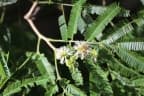
Albizia niopoides
Albizia niopoides
Safety & Hazards
None known
Cultivation Details
A plant of the lowland tropics where it can be found at elevations up to 1,000 metres. It grows best in areas where the mean annual rainfall is within the range 500 - 2,500mm[1]. It is usually found in areas with a pronounced dry season of 4 - 7 months[1]. Prefers a sunny position[2]. Prefers a deep, well-drained, alluvial soil rich in organic matter[1, 3]. A very wind-tolerant species, able to withstand hurricane-grade winds[1]. Established plants are drought tolerant[2]. A fast growing tree, easily reaching a height of 4 metres within 2 years from seed[2]. Plants can recover after a forest fire[4].
Propagation
Seed - best sown as soon as it is ripe in a partially shaded position in a nursery seedbed. A germination rate of less than 30% can be expected, with the seed sprouting within 10 - 40 days[2]. The seed of most, if not all, members of this genus develops a hard seedcoat as it matures and may benefit from scarification before sowing to speed up germination. This can usually be done by pouring a small amount of nearly boiling water on the seeds (being careful not to cook them!) and then soaking them for 12 - 24 hours in warm water. By this time they should have imbibed moisture and swollen - if they have not, then carefully make a nick in the seedcoat (being careful not to damage the embryo) and soak for a further 12 hours before sowing. When the seedlings are 3 - 5cm tall, pot them up into individual containers and they should be ready to plant out four months later[2]. Cite as: Tropical Plants Database, Ken Fern. tropical.theferns.info. 2026-02-19. <tropical.theferns.info/viewtropical.php?id=Albizia+niopoides>
Pollinators
Data unavailable
References
- [1]Dominica Botanic Gardens — http://www.da-academy.org/trees_shrubs.html ↩︎An on-line resource, providing top quality pictures and some basic information on various plants being grown at the Botanic Gardens, often including uses and habitat.
- [2]Brazilian Trees. Volume 1. 4th Edition. — Lorenzi. H. · Instituto Plantarum De Estudos Da Flora; Brazil. · 2002 · ISBN 85-86714-17-8 ↩︎Information on 350 species of Brazilian trees. Stunning photographs of each species, brief details on the plant, its uses and how to grow it from seed. A superb work, with the minor irritation that the translation from Portuguese is not of the best.
- [3]Establishment, growth and biomass production of 10 tree woody species introduced for reforestation and ecological re — Foroughbakhch R. et al · 2006 · http://10.1016/j.foreco.2006.08.012 ↩︎
- [4]A taxonomic study of Albizia (Leguminosae: Mimosoideae: Ingeae) in Mexico and Central America — Rico Arce M. De L.; Gale S.L.; Maxted N. · Anales del Jardín Botánico de Madrid; Madrid. · 2008 · ISBN 0211-1322 ↩︎A comprehensive treatment of the 12 species of Albizia found in Central America.
- [PFAF]Plants for a Future — pfaf.org ↩︎