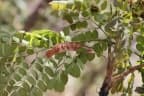
Albizia guachapele
Albizia guachapele
Safety & Hazards
None known
Cultivation Details
A plant of low to high elevations in the tropics, usually found below 500 metres, but up to 3,000 metres in Colombia. It requires a mean annual rainfall within the range 600 - 2,400mm, usually growing in areas with a dry season of up to 7 months[1]. Requires a sunny position, though young seedlings can tolerate some shade for their first two years[2]. Found in the wild on soil types ranging from sandy loam to gravel and rocks[3]. Requires a well-drained soil[3]. Very tolerant of shallow, infertile soils[2], though it grows best in deep, fertile soils[4].. A fast-growing tree[1]. When grown in the open this species develops a poor form for timber use, with a short bole and a wide spreading crown. However, if grown at a high density, and with artificial pruning during the first four years, it will develop a good bole for timber[2]. The tree is often left to provide shade when the forest is cleared for agriculture[1]. The plant can survive forest fires[3]. This species has a symbiotic relationship with certain soil bacteria, these bacteria form nodules on the roots and fix atmospheric nitrogen. Some of this nitrogen is utilized by the growing plant but some can also be used by other plants growing nearby[1].
Propagation
Seed - it has a hard seedcoat and may benefit from scarification before sowing to speed up germination. This can usually be done by pouring a small amount of nearly boiling water on the seeds (being careful not to cook them!) and then soaking them for 12 - 24 hours in warm water. By this time they should have imbibed moisture and swollen - if they have not, then carefully make a nick in the seedcoat (being careful not to damage the embryo) and soak for a further 12 hours before sowing. A high germination rate can usually be expected[1]. Cite as: Tropical Plants Database, Ken Fern. tropical.theferns.info. 2026-02-19. <tropical.theferns.info/viewtropical.php?id=Albizia+guachapele>
Pollinators
Insects
References
- [1]A taxonomic study of Albizia (Leguminosae: Mimosoideae: Ingeae) in Mexico and Central America — Rico Arce M. De L.; Gale S.L.; Maxted N. · Anales del Jardín Botánico de Madrid; Madrid. · 2008 · ISBN 0211-1322 ↩︎A comprehensive treatment of the 12 species of Albizia found in Central America.
- [2]World Agroforesty Centre — http://www.worldagroforestry.org/ ↩︎An excellent online database of a huge range of trees giving very good information on each plant - its uses, ecology, identity, propagation, pests etc.
- [3]South American Timbers: the Properties, Uses and Characteristics of 190 Species. — Bolza. E. & Christensen. F.J. · Commonwealth Scientific and Industrial Research Organization · 1979 · ISBN 0 643 02582 0 ↩︎A very useful guide.
- [4]Establishment, growth and biomass production of 10 tree woody species introduced for reforestation and ecological re — Foroughbakhch R. et al · 2006 · http://10.1016/j.foreco.2006.08.012 ↩︎