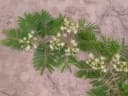
Albizia ferruginea
Albizia ferruginea
Safety & Hazards
The wood dust is aromatic and peppery. It may cause irritation to the nose and throat of sawmill workers[1, 2]. The root bark and the gum from the stem bark are used in the preparation of arrow poison[1]. The leaves are rich in saponins and are used as fish poison in the Central African Republic[1].
Cultivation Details
The plant, even as a seedling, demands a sunny position[1]. In exposed sites, seedlings may grow up to 3 metres tall in 5 years. In Ghana seedlings reached a height of 2 metres within 2 years[1]. In a selection test for agroforestry species on acid, aluminium toxic soils in southern Cameroon, seedlings reached a height of hardly 2 metres in 20 months, which was less than 20% of the height of the best performing species (Inga edulis and Pterocarpus santalinoides)[1]. Trees coppice well, but rates of regrowth, wood and leaf production have been slow in experiments[1]. The leaves show sleep movements at night[1]. Leaves fall after the rainy season, and new flushes are red[1]. This species has a symbiotic relationship with certain soil bacteria, these bacteria form nodules on the roots and fix atmospheric nitrogen. Some of this nitrogen is utilized by the growing plant but some can also be used by other plants growing nearby[1]. This species is highly dependent on arbuscular mycorrhizae[1].
Propagation
Seed - it has a hard seedcoat and may benefit from scarification before sowing to speed up germination. This can usually be done by pouring a small amount of nearly boiling water on the seeds (being careful not to cook them!) and then soaking them for 12 - 24 hours in warm water. By this time they should have imbibed moisture and swollen - if they have not, then carefully make a nick in the seedcoat (being careful not to damage the embryo) and soak for a further 12 hours before sowing. Sow the seed in a sunny position, preferably in situ but they can be growing in a nursery seedbed, Germination of treated seed usually takes 4 - 10 days, with up to 80% sprouting[1]. Experiments in Ghana showed that the plant can be successfully propagated vegetatively by root cuttings, without the application of rooting hormone[1]. Cite as: Tropical Plants Database, Ken Fern. tropical.theferns.info. 2026-02-19. <tropical.theferns.info/viewtropical.php?id=Albizia+ferruginea>
Pollinators
Bees, Insects
References
- [1]Protabase - Plant Resources of Tropical Africa. — http://www.prota.org ↩︎An excellent on-line database with detailed information on over 3,200 species of useful plants of Africa.
- [2]The Leguminosae; A Source Book of Characteristics, Uses and Nodulation — Allen O.N.; Allen E.K. · University of Wisconsin · 1981 · ISBN 0-333-32221-5 ↩︎An amazing and comprehensive work, giving a brief guide to the many genera of the family Fabaceae and also the principle uses of the genus.
- [3]IUCN Red List of Threatened Species — http://www.iucnredlist.org/ ↩︎A list of plants under threat and facing possible extinction, usually with brief details of the threats and information on habitat.
- [4]World Agroforesty Centre — http://www.worldagroforestry.org/ ↩︎An excellent online database of a huge range of trees giving very good information on each plant - its uses, ecology, identity, propagation, pests etc.