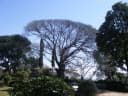
Albizia amara
Albizia amara
Safety & Hazards
It is believed that the seeds are poisonous[1].
Cultivation Details
A plant of semi-arid, tropical and subtropical areas, where it is found at elevations from 400 - 1,500 metres[1, 2]. It grows best in areas where annual daytime temperatures are within the range 15 - 40°c, but can tolerate 10 - 50°c[2]. It prefers a mean annual rainfall in the range 400 - 1,000mm, but tolerates 250 - 1,200mm[2]. Thrives in lighter soils, succeeding even when fertility is low, and is also able to tolerate clay soils[1, 2]. A strong light-demander, it is intolerant of shade, very hardy and shows marked resistance to drought[1]. Prefers a pH in the range 5 - 7, tolerating 4.5 - 8[2]. The yellow or pinkish-white, fragrant flower heads appear mainly in the rainy season, and the fruits ripen in the cold season[1]. The plant has a shallow and spreading root system[1]. It reproduces very freely from coppice; it produces a large number of coppice shoots in the first instance, producing as many as 50-100 shoots[1]. This species has a symbiotic relationship with certain soil bacteria, these bacteria form nodules on the roots and fix atmospheric nitrogen. Some of this nitrogen is utilized by the growing plant but some can also be used by other plants growing nearby[3].
Propagation
Seed - it has a hard seedcoat and may benefit from scarification before sowing to speed up germination. This can usually be done by pouring a small amount of nearly boiling water on the seeds (being careful not to cook them!) and then soaking them for 12 - 24 hours in warm water. By this time they should have imbibed moisture and swollen - if they have not, then carefully make a nick in the seedcoat (being careful not to damage the embryo) and soak for a further 12 hours before sowing. The treated seed can be then sown and will germinate within 7 - 10 days. Germination rate is about 80%[1]. The orthodox seeds can be stored up to 2.5 years without losing viability appreciably[1]. They are best stored in mud pots with wood ash or in sealed tins or gunny bags[1]. Cite as: Tropical Plants Database, Ken Fern. tropical.theferns.info. 2026-02-19. <tropical.theferns.info/viewtropical.php?id=Albizia+amara>
Pollinators
Insects
References
- [1]World Agroforesty Centre — http://www.worldagroforestry.org/ ↩︎An excellent online database of a huge range of trees giving very good information on each plant - its uses, ecology, identity, propagation, pests etc.
- [2]Ecocrop — http://ecocrop.fao.org/ecocrop/srv/en/home ↩︎Basic information on a wide range of useful plants, plus details of environmental needs where available.
- [3]The New RHS Dictionary of Gardening. 1992. — Huxley. A. · MacMillan Press · 1992 · ISBN 0-333-47494-5 ↩︎Excellent and very comprehensive, though it contains a number of silly mistakes. Readable yet also very detailed.
- [4]Trade in Indian Medicinal Plants — D.K.Ved, S.Noorunnisa Begum, & K.Ravi Kumar · Apple Academic Press; Oakville, Canada · 2018 · ISBN 978-1-77188-600-0 ↩︎
- [5]Protabase - Plant Resources of Tropical Africa. — http://www.prota.org ↩︎An excellent on-line database with detailed information on over 3,200 species of useful plants of Africa.
- [6]The Leguminosae; A Source Book of Characteristics, Uses and Nodulation — Allen O.N.; Allen E.K. · University of Wisconsin · 1981 · ISBN 0-333-32221-5 ↩︎An amazing and comprehensive work, giving a brief guide to the many genera of the family Fabaceae and also the principle uses of the genus.