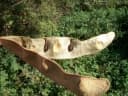
Albizia adianthifolia
Albizia adianthifolia
Safety & Hazards
None known
Cultivation Details
Albizia adianthifolia is found in a wide range of environments in tropical Africa, succeeding in wet woodlands right through to wooded savannah. It can be found at elevations up to 2,000 metres[1]. It grows best in areas where annual daytime temperatures are within the range 22 - 28°c, but can tolerate 15 - 34°c[2]. It prefers a mean annual rainfall in the range 1,500 - 2,500mm, but tolerates 900 - 4,000mm[2]. Succeeds on a wide range of soil types, preferring fertile, deep and sandy soils[1]. Plants can withstand periodic inundation of the soil[2]. Prefers a pH in the range 4.5 - 6.5, tolerating 4 - 7[2]. Trees can grow rapidly, with a recorded maximum early height growth of 2 metres per year[1]. However, growth of planted trees is often much less and even slow during the first years. In planting experiments in Ghana 3-years-old trees reached a height of on average 1.5 metres with a stem diameter of 1.5 cm[1]. Trees usually flower at the end of the dry season, just after or with the emergence of new leaves[1]. Trees respond well to coppicing[2]. Sometimes considered to be an aggressive colonizer[1]. This species has a symbiotic relationship with certain soil bacteria, these bacteria form nodules on the roots and fix atmospheric nitrogen. Some of this nitrogen is utilized by the growing plant but some can also be used by other plants growing nearby[3].
Propagation
Seed - it has a hard seedcoat and may benefit from scarification before sowing to speed up germination. This can usually be done by pouring a small amount of nearly boiling water on the seeds (being careful not to cook them!) and then soaking them for 12 - 24 hours in warm water. By this time they should have imbibed moisture and swollen - if they have not, then carefully make a nick in the seedcoat (being careful not to damage the embryo) and soak for a further 12 hours before sowing. Seedlings are classified as strong light demanders. The germination rate of seeds in the light and dark may be equal, but seedlings soon die in the shade. Regeneration is most abundant in forest disturbed by logging. In burnt forest, seedlings are less abundant. There are about 25,000 seeds per kg. Seeds should be collected from pods still attached to the tree to reduce damage by insects, and they should be dried immediately after collection. They can be stored for up to 3 months if ash is added to reduce insect damage. In cultivation seed may be used for propagation, but wildlings are sometimes also used for planting. Experiments in Ghana showed that Albizia adianthifolia can be successfully propagated vegetatively by root cuttings. Cite as: Tropical Plants Database, Ken Fern. tropical.theferns.info. 2026-02-19. <tropical.theferns.info/viewtropical.php?id=Albizia+adianthifolia>
Pollinators
Insects
References
- [1]Protabase - Plant Resources of Tropical Africa. — http://www.prota.org ↩︎An excellent on-line database with detailed information on over 3,200 species of useful plants of Africa.
- [2]Ecocrop — http://ecocrop.fao.org/ecocrop/srv/en/home ↩︎Basic information on a wide range of useful plants, plus details of environmental needs where available.
- [3]The New RHS Dictionary of Gardening. 1992. — Huxley. A. · MacMillan Press · 1992 · ISBN 0-333-47494-5 ↩︎Excellent and very comprehensive, though it contains a number of silly mistakes. Readable yet also very detailed.
- [4]Flora of Southern Africa — Roux J.P. · 2003 · http://plants.jstor.org/search?st=662545 ↩︎An excellent on-line resource.
- [5]IUCN Red List of Threatened Species — http://www.iucnredlist.org/ ↩︎A list of plants under threat and facing possible extinction, usually with brief details of the threats and information on habitat.