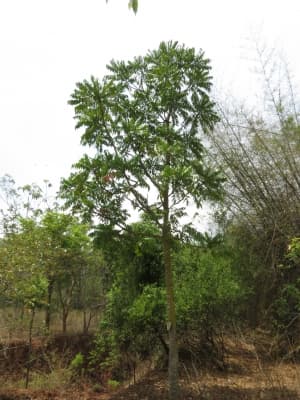
Simaroubaceae FAMILY
Ailanthus triphysa
Ailanthus triphysa
Edibility
0/5
Medicinal
2/5
Safety & Hazards
None known
Cultivation Details
HabitEvergreen Tree
GrowthFast
A tree of the wet tropical evergreen lowland forests, it grows best at an altitude of 60 - 1,500 metres where the mean annual temperature is around 27°c and the mean annual rainfall is around 1,920 mm[1]. Requires a position in full sun[1]. Prefers a well-drained, light sandy soil[1]. A fast-growing tree[2]. A dioecious species, both male and female forms need to be grown if fruit and seed are required[2]. The flowers of male plants emit a foetid, disgusting smell and, for that reason, male trees are not desirable to cultivate as an ornamental[2].
References
- [1]World Agroforesty Centre — http://www.worldagroforestry.org/ ↩︎An excellent online database of a huge range of trees giving very good information on each plant - its uses, ecology, identity, propagation, pests etc.
- [2]Flora Malesiana Series 1 — Various · Nationaal Herbarium Nederiand, Universiteit Leiden branch · http://www.archive.org ↩︎A massive treatment of the plants of the Malaysian Archipelago. Much of it has been made available to download from the Internet
- [3]Plant Resources of Southeast Asia — http://proseanet.org/ ↩︎Lots of information on the uses of the plants of SE Asia.
- [4]Brisbane Rainforest Action and Information Network, — http://www.brisrain.webcentral.com.au ↩︎Information on plants in the Queensland Rainforests.
- [5]Dictionary of Economic Plants. — Uphof. J. C. Th. · Weinheim · 1959 · ISBN - ↩︎An excellent and very comprehensive guide but it only gives very short descriptions of the uses without any details of how to utilize the plants. Not for the casual reader.
- [6]The Useful Native Plants of Australia. — Maiden J.H. · Turner & Co.; London. · 1889 · http://www.biodiversitylibrary.org ↩︎Terse details of the uses of many Australian plants and other species naturalised, or at least growing, in Australia. It can be downloaded from the Internet.