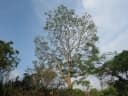
Ailanthus excelsa
Ailanthus excelsa
Safety & Hazards
None known
Cultivation Details
A plant of the semi-arid to wet tropics, where it is found at elevations up to 900 metres. It grows best in areas where annual daytime temperatures are within the range 20 - 40°c, but can tolerate 4 - 47°c[1]. Mature plants can be killed by temperatures of -5°c or lower, but new growth can be killed at -1°c[1]. It prefers a mean annual rainfall in the range 600 - 1,900mm, but tolerates 400 - 2,500mm[1]. Grows best in a very sunny position[1]. Prefers a light to medium soil, growing well in sandy soils of medium to low fertility so long as there is adequate moisture[2, 1]. Plants are relatively tolerant of salt in the soil[2]. The branches are rather brittle, so a position sheltered from strong winds is preferred[1]. Prefers a pH in the range 5 - 6, tolerating 4.5 - 7[1]. Mature plants are drought tolerant[2]. A fast-growing tree[1]. The tree coppices well and produces root suckers that should be thinned to reduce competition[2]. Survivability of newly planted trees is poor if the trees are not sufficiently watered during their first and second years of growth[1]. A dioecious species, both male and female forms need to be grown if seed is required.
Propagation
Seed - it can be stored for 12 months or more in open storage[2]. Cite as: Tropical Plants Database, Ken Fern. tropical.theferns.info. 2026-02-19. <tropical.theferns.info/viewtropical.php?id=Ailanthus+excelsa>
Pollinators
Data unavailable
References
- [1]Ecocrop — http://ecocrop.fao.org/ecocrop/srv/en/home ↩︎Basic information on a wide range of useful plants, plus details of environmental needs where available.
- [2]World Agroforesty Centre — http://www.worldagroforestry.org/ ↩︎An excellent online database of a huge range of trees giving very good information on each plant - its uses, ecology, identity, propagation, pests etc.
- [3]A Manual of Indian Timbers. — Gamble. J. S. · Bishen Singh Mahendra Pal Singh · 1972 · ISBN - ↩︎First written in the 19th century, but still a classic, giving a lot of information on the uses and habitats of Indian trees. Not for the casual reader.
- [4]Flowers of India — http://www.flowersofindia.net/ ↩︎A wed site of native Indian plants, plus cultivated and naturalized species. It has good quality photos and terse details on more than 3,000 species and cultivars.
- [5]Plant Resources of Southeast Asia — http://proseanet.org/ ↩︎Lots of information on the uses of the plants of SE Asia.