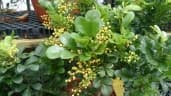
Meliaceae FAMILY Near Threatened
Aglaia odorata
Aglaia odorata
Edibility
2/5
Medicinal
2/5
Safety & Hazards
None known
Cultivation Details
HabitEvergreen Shrub
GrowthSlow
Often found growing on clay soils in the wild[1]. The plant produces fragrant flowers for much of the year[1]. The fragrance is most intense in the evening[2]. The female form is rare in cultivation because the flowers are not as aromatic as the male plant[1]. A dioecious species, both male and female forms need to be grown if seed is required.
Propagation
Seed - Cuttings[1]. Cite as: Tropical Plants Database, Ken Fern. tropical.theferns.info. 2026-02-19. <tropical.theferns.info/viewtropical.php?id=Aglaia+odorata>
Pollinators
Insects
References
- [1]A Taxonomic Monograph of the Genus Aglaia Lour. (Meliaceae) — Pannell C.M. · HMSO; London · 1992 · ISBN 0-11-250067-6 ↩︎A comprehensive treatment of the genus Aglaia, including the genus Amoora. Very good plant descriptions, it also gives some plant uses, details of habitat, range etc.
- [2]Philippine Medicinal Plants — http://www.stuartxchange.org/CompleteList.html ↩︎A lovely site, giving brief details on the medicinal uses of several hundred (over 400 at the last count) plants in the Philippines, plus a picture of each plant.
- [3]Flora Malesiana Series 1 — Various · Nationaal Herbarium Nederiand, Universiteit Leiden branch · http://www.archive.org ↩︎A massive treatment of the plants of the Malaysian Archipelago. Much of it has been made available to download from the Internet
- [4]Plants of Southeast Asia — http://www.asianplant.net/ ↩︎Excellent site with brief information on the plant, its range, habitat and uses, plus phots of specimens, close-ops of flowers and leaves etc,
- [5]Dictionary of Economic Plants. — Uphof. J. C. Th. · Weinheim · 1959 · ISBN - ↩︎An excellent and very comprehensive guide but it only gives very short descriptions of the uses without any details of how to utilize the plants. Not for the casual reader.
- [6]Mansfeld's Database of Agricultural and Horticultural Plants — http://mansfeld.ipk-gatersleben.de/pls/htmldb_pgrc/f?p=185:3:4292127278597336 ↩︎Terse details of a huge range of useful plants.
- [7]IUCN Red List of Threatened Species — http://www.iucnredlist.org/ ↩︎A list of plants under threat and facing possible extinction, usually with brief details of the threats and information on habitat.
- [8]Flora of China — Missouri Botanical Garden Press; St. Louis. · 1994 · http://flora.huh.harvard.edu/china/ ↩︎An excellent, comprehensive resource in 25 volumes. In addition to the botanical information the flora also gives basic information on habitat and some uses. An on-line version is also available.
- [9]Thai Forest Bulletin (Botany) No. 39 — Thawatchai Santisuk (Editor) · The Forest Herbarium (BKF); Chatuchak, Bangkok. · 2011 · ISBN 0495-3843 ↩︎A botanical journal, publishing papers on taxonomy (especially vascular plants), nomenclature, phylogeny, systematics, plant geography, and floristics; also morphology, palynology, cytotaxonomy, chemotaxonomy, anatomy and other relevant disciplines.
- [10]Cornucopia II — Facciola. S. · Kampong Publications, California. · 1998 · ISBN 0-9628087-2-5 ↩︎The second edition of an excellent guide to the edible uses of plants, though it does not give any details of cultivation etc.
- [11]Encyclopaedia of Herbs and their Uses. — Bown. D. · Dorling Kindersley, London. · 1995 · ISBN 0-7513-020-31 ↩︎A very well presented and informative book on herbs from around the globe. Plenty in it for both the casual reader and the serious student. Just one main quibble is the silly way of having two separate entries for each plant.
- [12]Tree Flora of Sabah and Sarawak Vols 1 - 6 — Soepadmo E.; Saw L.G.; Chung R.C.K. (Editors) · Forest Research Institute Malaysia; Kuala Lumpur. · 2002 · ISBN 983-2181-27-5 ↩︎A flora of the woody plants of Sabah and Sarawak on the island of Borneo, often giving details of plant uses.
- [13]The World List of Threatened Trees — Oldfield S.; Lusty C.; and MacKinven A. · World Conservation Press; Cambridge UK · 1998 · http://www.biodiversitylibrary.org · ISBN 1-899628-10 X ↩︎A list of the trees on the IUCN Red List of Threatened Plant Species in 1998, often giving some information on habitat and the reasons for being on the list. It can be downloaded from the Internet.