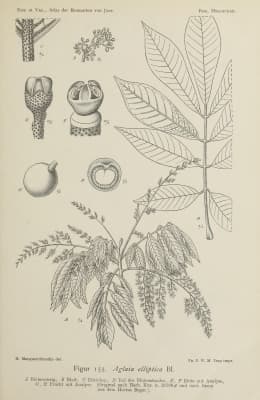
Meliaceae FAMILY Least Concern
Aglaia elliptica
Aglaia elliptica
Edibility
2/5
Medicinal
2/5
Safety & Hazards
None known
Cultivation Details
HabitEvergreen Tree
Growth—
A plant of the tropics, growing at elevations from sea level to 2,000 metres[1]. Plants often withstand periodic inundation of the soil in their native habitats[2]. All the fruits on any one infructescence ripen more or less together, but there are many infructescences on any one tree and these can ripen over a period of several weeks or months, thereby giving a prolonged season of fruit harvest[2]. The male flowers are sweetly scented[2]. A dioecious species, both male and female forms need to be grown if fruit and seed are required.
Propagation
Seed - Cite as: Tropical Plants Database, Ken Fern. tropical.theferns.info. 2026-02-19. <tropical.theferns.info/viewtropical.php?id=Aglaia+elliptica>
Pollinators
Insects
References
- [1]World Agroforesty Centre — http://www.worldagroforestry.org/ ↩︎An excellent online database of a huge range of trees giving very good information on each plant - its uses, ecology, identity, propagation, pests etc.
- [2]A Taxonomic Monograph of the Genus Aglaia Lour. (Meliaceae) — Pannell C.M. · HMSO; London · 1992 · ISBN 0-11-250067-6 ↩︎A comprehensive treatment of the genus Aglaia, including the genus Amoora. Very good plant descriptions, it also gives some plant uses, details of habitat, range etc.
- [3]Flora Malesiana Series 1 — Various · Nationaal Herbarium Nederiand, Universiteit Leiden branch · http://www.archive.org ↩︎A massive treatment of the plants of the Malaysian Archipelago. Much of it has been made available to download from the Internet
- [4]IUCN Red List of Threatened Species — http://www.iucnredlist.org/ ↩︎A list of plants under threat and facing possible extinction, usually with brief details of the threats and information on habitat.
- [5]Plants of Southeast Asia — http://www.asianplant.net/ ↩︎Excellent site with brief information on the plant, its range, habitat and uses, plus phots of specimens, close-ops of flowers and leaves etc,
- [6]Dictionary of Economic Plants. — Uphof. J. C. Th. · Weinheim · 1959 · ISBN - ↩︎An excellent and very comprehensive guide but it only gives very short descriptions of the uses without any details of how to utilize the plants. Not for the casual reader.
- [7]Plant Resources of Southeast Asia — http://proseanet.org/ ↩︎Lots of information on the uses of the plants of SE Asia.
- [8]Biotik, Laos — http://biotik.org/species_list_laos.html ↩︎Information on more than 100 species of Laotian trees.
- [9]Flora of China — Missouri Botanical Garden Press; St. Louis. · 1994 · http://flora.huh.harvard.edu/china/ ↩︎An excellent, comprehensive resource in 25 volumes. In addition to the botanical information the flora also gives basic information on habitat and some uses. An on-line version is also available.
- [10]Tree Flora of Sabah and Sarawak Vols 1 - 6 — Soepadmo E.; Saw L.G.; Chung R.C.K. (Editors) · Forest Research Institute Malaysia; Kuala Lumpur. · 2002 · ISBN 983-2181-27-5 ↩︎A flora of the woody plants of Sabah and Sarawak on the island of Borneo, often giving details of plant uses.
- [11]Commercial Woods of the Philippines; Their Preparation and Uses — Schneider E.E. · Bureau of Forestry; Manilla. · 1916 · http://www.biodiversitylibrary.org ↩︎A series of booklets dealing with various aspects of the Philippine forests. This volume looks at the preparation and uses of the commercial woods of the Philippines. It can be downloaded from the Internet.