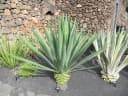
Agave fourcroydes
Agave fourcroydes
Safety & Hazards
Many Agave species have strong, sharp spines on the leaves and leaf tips. In theory at least, the flowers, nectar, immature flowering stem and the centre of the rosette of all Agave species is edible and, with proper preparation, can provide a sweet, tasty foodstuff. Some species, however, contain relatively high levels of saponins (which makes them taste bitter) and some other compounds which can cause bellyache, and so these would only be eaten in times of desperation. In addition, many people may find these foods to be strongly laxative the first few times they eat them[1].
Cultivation Details
A plant of the drier tropics. It grows best in areas where annual daytime temperatures are within the range 15 - 30°c, but can tolerate 10 - 40°c[2]. It can be damaged by temperatures of -5°c or lower[2]. It prefers a mean annual rainfall in the range 900 - 1,250mm, but tolerates 700 - 2,500mm[2]. Requires a sunny position in a well-drained soil. Prefers a pH in the range 6.5 - 7.5, tolerating 6 - 8[2]. It require 4 - 6 years to first harvest, and the leaves can subsequently be harvested twice a year[2]. Agave species are monocarpic, individual plants living for a number of years without flowering then sending up an often very large flowering stem and then dying after flowering and setting seed. The plants of most species, however, normally produce a number of new plants from suckers during their lifespan and these new plants will continue the life-cycle. Over time, some plants can form extensive clonal colonies by this means[3]. Individual plants take about 7 - 15 years in their native habitat, considerably longer in colder climates, before flowering[3]. In Mexico the plant has a life cycle of 15 - 30 years[2]. This species is a sterile hybrid taxon[4]. Propagation is made by transplanting the rhizomatous offsets produced during the early years of growth. They are preferred over the bulbils of the inflorescence because they grow more vigorously and require fewer years to reach the commercial production stage[5].
Propagation
Seed - this species rarely produces seed. Where it is produced, surface sow in a container in a light position. The seed usually germinates in 1 - 3 months at 15 - 20°c[6, 7]. Prick out the seedlings into individual pots of well-drained soil when they are large enough to handle and grow them on in a sunny position until they are at least 10cm tall before planting out. Offsets and suckers can be potted up at any time they are available. Bulbils, where produced, are an easy method of propagation. Simply pot them up and plant out at the beginning of a growing season when they are 10cm or more tall. Cite as: Tropical Plants Database, Ken Fern. tropical.theferns.info. 2026-02-19. <tropical.theferns.info/viewtropical.php?id=Agave+fourcroydes>
Pollinators
Data unavailable
References
- [1]The Agaves of Baja California — Gentry H.S. · California Academy of Sciences; San Francisco · 1978 · ISBN 0068-5461 ↩︎
- [2]Ecocrop — http://ecocrop.fao.org/ecocrop/srv/en/home ↩︎Basic information on a wide range of useful plants, plus details of environmental needs where available.
- [3]Trees and Shrubs Hardy in Great Britain. Vol 1 - 4 and Supplement. — Bean. W. · Murray · 1981 · ISBN - ↩︎A classic with a wealth of information on the plants, but poor on pictures.
- [4]Mansfeld's Database of Agricultural and Horticultural Plants — http://mansfeld.ipk-gatersleben.de/pls/htmldb_pgrc/f?p=185:3:4292127278597336 ↩︎Terse details of a huge range of useful plants.
- [5]The Agave Family in Sonora; Agriculture Handbook No. 399 — Gentry H.S. · Agicultural Research Service, USDA; Washington D.C. · 1972 ↩︎Gives quite a lot of information on the traditional uses of the plants.
- [6]Growing from Seed. Volume 1. — Rice. G. (Editor) · Thompson and Morgan. · 1987 · ISBN - ↩︎Very readable magazine with lots of information on propagation.
- [7]The New RHS Dictionary of Gardening. 1992. — Huxley. A. · MacMillan Press · 1992 · ISBN 0-333-47494-5 ↩︎Excellent and very comprehensive, though it contains a number of silly mistakes. Readable yet also very detailed.
- [8]Agave Agavaceae — Thiede J. · Springer Nature · 2020 · https://doi.org/10.1007/978-3-662-56486-8_111 ↩︎
- [9]Population Dynamics and Sustainable Management of Mescal Agaves in Central Mexico: Agave potatorum in the Tehuacán-C — Toees I. et al · 2015 · https://doi.org/10.1007/s12231-014-9295-2. ↩︎
- [10]Flora of Guatemala — Standley P.C. & J. A. Steyermark · 1946 - 1976 · http://www.archive.org/ ↩︎A superb reference, though somewhat dated. Gives lots of plant uses as well as information on plant habit and habitat. The entire flora (13 volumes) can now be downloaded from http://www.archive.org/