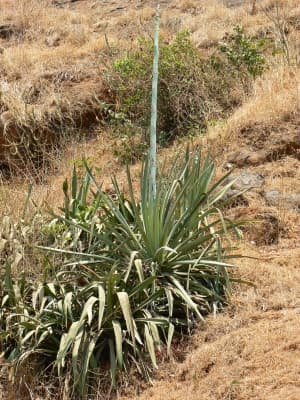
Agave cantala
Agave cantala
Safety & Hazards
Many Agave species have strong, sharp spines on the leaves and leaf tips. In theory at least, the flowers, nectar, immature flowering stem and the centre of the rosette of all Agave species is edible and, with proper preparation, can provide a sweet, tasty foodstuff. Some species, however, contain relatively high levels of saponins (which makes them taste bitter) and some other compounds which can cause bellyache, and so these would only be eaten in times of desperation. In addition, many people may find these foods to be strongly laxative the first few times they eat them[1].
Cultivation Details
Agave cantala is a plant of the drier tropics. It grows best in areas where annual daytime temperatures are within the range 17 - 30°c, but can tolerate 10 - 38°c[2]. It is able to withstand occasional temperatures down to at least -4°c, so long as the weather and soil are fairly dry[3]. It prefers a mean annual rainfall in the range 1,000 - 2,000mm, but tolerates 400 - 2,700mm[2]. Requires a sunny position in a well-drained soil. Prefers a pH in the range 6.5 - 7.5, tolerating 6 - 8[2]. The leaves contain about 4% fibre and yields of clean fibre vary between 1.1 - 3 tonnes per hectare[2]. Agave species generally require a sunny position, succeeding in most soils of medium-fertility so long as they are very well-drained. Most species are undemanding as to the soil pH, though those found in the wild on limestone soils will grow better in neutral to alkaline conditions. Plants are generally very tolerant of dry conditions and of extended periods of drought[4]. Most Agave species are monocarpic, individual rosettes living for a number of years without flowering before sending up an often very large flowering stem and then dying after flowering and setting seed. This species, however, produces a number of new rosettes from suckers or offsets during its lifespan and these new plants will continue to grow after the death of the parent plant. Over time, some species can form extensive clonal colonies by this means[5]. Individual plants take about 7 - 15 years in their native habitat, considerably longer in colder climates, before flowering[5]. Members of this genus are rarely if ever troubled by browsing deer[6]. The plant has a lifespan of more than 15 - 30 years[2].
Propagation
Seed - surface sow in a container in a light position. The seed usually germinates in 1 - 3 months at 15 - 20°c[7, 4]. Prick out the seedlings into individual pots of well-drained soil when they are large enough to handle and grow them on in a sunny position until they are at least 10cm tall before planting out. Offsets and suckers can be potted up at any time they are available. Bulbils, where produced, are an easy method of propagation. Simply pot them up and plant out at the beginning of a growing season when they are 10cm or more tall. Cite as: Tropical Plants Database, Ken Fern. tropical.theferns.info. 2026-02-19. <tropical.theferns.info/viewtropical.php?id=Agave+cantala>
Pollinators
Data unavailable
References
- [1]The Agaves of Baja California — Gentry H.S. · California Academy of Sciences; San Francisco · 1978 · ISBN 0068-5461 ↩︎
- [2]Ecocrop — http://ecocrop.fao.org/ecocrop/srv/en/home ↩︎Basic information on a wide range of useful plants, plus details of environmental needs where available.
- [3]Desert Tropicals — http://www.desert-tropicals.com/ ↩︎The main focus of the site is succulent plants, but it also contains information on a wide range of other species. Usually at least one good photograph, plus basic information about the plant and its cultivation.
- [4]The New RHS Dictionary of Gardening. 1992. — Huxley. A. · MacMillan Press · 1992 · ISBN 0-333-47494-5 ↩︎Excellent and very comprehensive, though it contains a number of silly mistakes. Readable yet also very detailed.
- [5]Trees and Shrubs Hardy in Great Britain. Vol 1 - 4 and Supplement. — Bean. W. · Murray · 1981 · ISBN - ↩︎A classic with a wealth of information on the plants, but poor on pictures.
- [6]Perennial Garden Plants — Thomas. G. S. · J. M. Dent & Sons, London. · 1990 · ISBN 0 460 86048 8 ↩︎A concise guide to a wide range of perennials. Lots of cultivation guides, very little on plant uses.
- [7]Growing from Seed. Volume 1. — Rice. G. (Editor) · Thompson and Morgan. · 1987 · ISBN - ↩︎Very readable magazine with lots of information on propagation.
- [8]Population Dynamics and Sustainable Management of Mescal Agaves in Central Mexico: Agave potatorum in the Tehuacán-C — Toees I. et al · 2015 · https://doi.org/10.1007/s12231-014-9295-2. ↩︎
- [9]Mansfeld's Database of Agricultural and Horticultural Plants — http://mansfeld.ipk-gatersleben.de/pls/htmldb_pgrc/f?p=185:3:4292127278597336 ↩︎Terse details of a huge range of useful plants.
- [10]Ethnobotanical Uses of Biofencing Plants in Himachel Pradesh, Northwest Himalaya — Pankaj Sharma & Usha Devi · 2013 · ISBN 1028-8880 ↩︎A brief look at 61 species of plants used in hedging in northwest Himalayas nd their other uses
- [11]Descriptive Notes on Fibres prepared for the Greater Britain and Paris Exhibitions — Guilfoyle W.R. · Melbourne Botanic Gardens; Melbourne · 1899 ↩︎A list of more than 100 fibre-producing plant species with notes on how the fibre is ectracted.
- [12]Flora of Guatemala — Standley P.C. & J. A. Steyermark · 1946 - 1976 · http://www.archive.org/ ↩︎A superb reference, though somewhat dated. Gives lots of plant uses as well as information on plant habit and habitat. The entire flora (13 volumes) can now be downloaded from http://www.archive.org/
- [PFAF]Plants for a Future — pfaf.org ↩︎