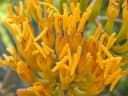
Agave angustifolia
Agave angustifolia
Safety & Hazards
Many Agave species have strong, sharp spines on the leaves and leaf tips. In theory at least, the flowers, nectar, immature flowering stem and the centre of the rosette of all Agave species is edible and, with proper preparation, can provide a sweet, tasty foodstuff. Some species, however, contain relatively high levels of saponins (which makes them taste bitter) and some other compounds which can cause bellyache, and so these would only be eaten in times of desperation. In addition, many people may find these foods to be strongly laxative the first few times they eat them[1].
Cultivation Details
Agave angustifolia is a very environmentally versatile Agave due to its wide latitudinal distribution range (it can be found from the north of Mexico to Costa Rica and Panama). The species is also found in Pine-Oak forest with tropical influence in the pacific range of Mexico. The most extreme habitats the species occupies are the arid Sonoran Desert, with an average annual precipitation of 250mm, and the pine-oak forest close to Uruapan Michoacán, with a mean annual rainfall of 1,680mm. The northern forms can survive winter frost without damage; whilst the tropical ones are more or less sensitive to low temperatures[2]. A plant of drier areas in the tropics, northern forms can tolerate temperatures down to at least -4°c so long as the conditions are dry[3]. Requires a sunny position[3]. Requires a well-drained soil[3]. Succeeds in poor soils[3]. Established plants are very drought resistant[3]. Most Agave species are monocarpic, individual rosettes living for a number of years without flowering before sending up an often very large flowering stem and then dying after flowering and setting seed. This species, however, produces a number of new rosettes from suckers or offsets during its lifespan and these new plants will continue to grow after the death of the parent plant[4] The flowering stem can produce an abundance of bulbils[4] Individual plants take about 7 - 15 years in their native habitat, considerably longer in colder climates, before flowering[5]. Agave angustifolia is the wild progenitor of the cultivated species Agave tequilana (which is mainly used for producing alcoholic beverages) and Agave fourcroydes (which is mainly used for fibre production)[4].
Propagation
Seed - surface sow in a light position, mid spring in a warm greenhouse. The seed usually germinates in 1 - 3 months at 15 - 20°c[6, 7]. Prick out the seedlings into individual pots of well-drained soil when they are large enough to handle and grow them on in a sunny position in the greenhouse until they are at least 15cm tall. Plant out at the beginning of the growing season, and give some protection from the cold for at least their first few winters[PFAF]. Offsets and suckers can be potted up at any time they are available. Keep in a warm greenhouse until they are well established[7]. Bulbils, where produced, are an easy method of propagation. Simply pot them up and plant out at the beginning of a growing season when they are 10cm or more tall. Cite as: Temperate Plants Database, Ken Fern. temperate.theferns.info. 2026-02-20. <temperate.theferns.info/plant/Agave+angustifolia>
Pollinators
Data unavailable
References
- [1]The Agaves of Baja California — Gentry H.S. · California Academy of Sciences; San Francisco · 1978 · ISBN 0068-5461 ↩︎
- [2]IUCN Red List of Threatened Species — http://www.iucnredlist.org/ ↩︎A list of plants under threat and facing possible extinction, usually with brief details of the threats and information on habitat.
- [3]Desert Tropicals — http://www.desert-tropicals.com/ ↩︎The main focus of the site is succulent plants, but it also contains information on a wide range of other species. Usually at least one good photograph, plus basic information about the plant and its cultivation.
- [4]Agave Agavaceae — Thiede J. · Springer Nature · 2020 · https://doi.org/10.1007/978-3-662-56486-8_111 ↩︎
- [5]Trees and Shrubs Hardy in Great Britain. Vol 1 - 4 and Supplement. — Bean. W. · Murray · 1981 · ISBN - ↩︎A classic with a wealth of information on the plants, but poor on pictures.
- [6]Growing from Seed. Volume 1. — Rice. G. (Editor) · Thompson and Morgan. · 1987 · ISBN - ↩︎Very readable magazine with lots of information on propagation.
- [7]The New RHS Dictionary of Gardening. 1992. — Huxley. A. · MacMillan Press · 1992 · ISBN 0-333-47494-5 ↩︎Excellent and very comprehensive, though it contains a number of silly mistakes. Readable yet also very detailed.
- [8]The confusion of Agave vivipara L. and A. angustifolia Haw., two distinct taxa. — Garcia-Mendoza A.; Chiang F. · Brittonia; New York · 2003 ↩︎An article setting out the reasons why Agave angustifolia should be treated as a distinct species with a different range to Agave vivipara..
- [9]Population Dynamics and Sustainable Management of Mescal Agaves in Central Mexico: Agave potatorum in the Tehuacán-C — Toees I. et al · 2015 · https://doi.org/10.1007/s12231-014-9295-2. ↩︎
- [10]Flora of Guatemala — Standley P.C. & J. A. Steyermark · 1946 - 1976 · http://www.archive.org/ ↩︎A superb reference, though somewhat dated. Gives lots of plant uses as well as information on plant habit and habitat. The entire flora (13 volumes) can now be downloaded from http://www.archive.org/
- [11]The Warihio Indians of Sonora-Chihuahua; An Ethnographic Survey (Anthropological Papers, No. 65) — Gentry H.S. · Smithsonian Institution · 1963 ↩︎An excellent study
- [12]Taxonomy, Distribution, and Ecology of the Genus Phaseolus (Leguminosae-Papilionoideae) in North America, Mexico and — Freytag G.F. & Debouck D.G. · Botanical Researeh Institute of Texas · 2002 · http://www.brit.org/sida · ISBN 1-889878-11-1 ↩︎An excellent, detailed study of the genus Phaseolus, it has been made available on-line as an open access document.
- [13]The Agave Family in Sonora; Agriculture Handbook No. 399 — Gentry H.S. · Agicultural Research Service, USDA; Washington D.C. · 1972 ↩︎Gives quite a lot of information on the traditional uses of the plants.
- [14]Philippine Medicinal Plants — http://www.stuartxchange.org/CompleteList.html ↩︎A lovely site, giving brief details on the medicinal uses of several hundred (over 400 at the last count) plants in the Philippines, plus a picture of each plant.
- [15]Descriptive Notes on Fibres prepared for the Greater Britain and Paris Exhibitions — Guilfoyle W.R. · Melbourne Botanic Gardens; Melbourne · 1899 ↩︎A list of more than 100 fibre-producing plant species with notes on how the fibre is ectracted.
- [16]CosIng — http://ec.europa.eu/growth/tools-databases/cosing/ ↩︎CosIng is the European Commission database for information on cosmetic substances and ingredients.
- [PFAF]Plants for a Future — pfaf.org ↩︎