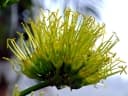
Agave americana
Agave americana
Safety & Hazards
Contact with the fresh sap can cause dermatitis in sensitive people[1, 2]. The plants have a very sharp and tough spine at the tip of each leaf. They need to be carefully sited in the garden. In theory at least, the flowers, nectar, immature flowering stem and the centre of the rosette of all Agave species is edible and, with proper preparation, can provide a sweet, tasty foodstuff. Some species, however, contain relatively high levels of saponins (which makes them taste bitter) and some other compounds which can cause bellyache, and so these would only be eaten in times of desperation. In addition, many people may find these foods to be strongly laxative the first few times they eat them[3].
Cultivation Details
Agave americana is native to semi-arid areas in the warm temperate and subtropical zones, though it has often also been cultivated in the Tropics. It is not very cold hardy, tolerating temperatures down to about -3°c or lower if conditions are not wet[4]. We have seen well-sited plants in southwest England that were undamaged by temperatures that fell below -5°c[PFAF]. Requires a very well-drained soil and a sunny position[5, 6]. Succeeds in poor soils[7]. Established plants are very drought resistant[7]. Agave species are monocarpic, individual plants living for a number of years without flowering then sending up an often very large flowering stem and then dying after flowering and setting seed. The plants of most species, however, normally produce a number of new plants from suckers during their lifespan and these new plants will continue the life-cycle. Over time, some plants can form extensive clonal colonies by this means[8]. Individual plants take about 7 - 15 years in their native habitat, considerably longer in colder climates, before flowering[8]. Members of this genus are rarely if ever troubled by browsing deer[9].
Propagation
Seed - surface sow in a light position, mid spring in a warm greenhouse. The seed usually germinates in 1 - 3 months at 15 - 20°c[10, 6]. Prick out the seedlings into individual pots of well-drained soil when they are large enough to handle and grow them on in a sunny position in the greenhouse until they are at least 15cm tall. Plant out at the beginning of the growing season, and give some protection from the cold for at least their first few winters[PFAF]. Offsets and suckers can be potted up at any time they are available. Keep in a warm greenhouse until they are well established[6]. Bulbils, where produced, are an easy method of propagation. Simply pot them up and plant out at the beginning of a growing season when they are 10cm or more tall. Cite as: Temperate Plants Database, Ken Fern. temperate.theferns.info. 2026-02-20. <temperate.theferns.info/plant/Agave+americana>
Pollinators
Lepidoptera, Bats
References
- [1]Medicinal Plants of China — Duke. J. A. and Ayensu. E. S. · Reference Publications, Inc. · 1985 · ISBN 0-917256-20-4 ↩︎Details of over 1,200 medicinal plants of China and brief details of their uses. Often includes an analysis, or at least a list of constituents. Heavy going if you are not into the subject.
- [2]Encyclopaedia of Herbs and their Uses. — Bown. D. · Dorling Kindersley, London. · 1995 · ISBN 0-7513-020-31 ↩︎A very well presented and informative book on herbs from around the globe. Plenty in it for both the casual reader and the serious student. Just one main quibble is the silly way of having two separate entries for each plant.
- [3]The Agaves of Baja California — Gentry H.S. · California Academy of Sciences; San Francisco · 1978 · ISBN 0068-5461 ↩︎
- [4]Conservatory and Indoor Plants Volumes 1 & 2 — Phillips. R. & Rix. M. · Pan Books, London. · 1998 · ISBN 0-330-37376-5 ↩︎Excellent photos of over 1,100 species and cultivars with habits and cultivation details plus a few plant uses. Many species are too tender for outdoors in Britain though there are many that can be grown outside.
- [5]RHS Dictionary of Plants plus Supplement. 1956 — F. Chittendon. · Oxford University Press · 1951 · ISBN - ↩︎Comprehensive listing of species and how to grow them. Somewhat outdated, it has been replaced in 1992 by a new dictionary (see [ 200 ]).
- [6]The New RHS Dictionary of Gardening. 1992. — Huxley. A. · MacMillan Press · 1992 · ISBN 0-333-47494-5 ↩︎Excellent and very comprehensive, though it contains a number of silly mistakes. Readable yet also very detailed.
- [7]Desert Tropicals — http://www.desert-tropicals.com/ ↩︎The main focus of the site is succulent plants, but it also contains information on a wide range of other species. Usually at least one good photograph, plus basic information about the plant and its cultivation.
- [8]Trees and Shrubs Hardy in Great Britain. Vol 1 - 4 and Supplement. — Bean. W. · Murray · 1981 · ISBN - ↩︎A classic with a wealth of information on the plants, but poor on pictures.
- [9]Perennial Garden Plants — Thomas. G. S. · J. M. Dent & Sons, London. · 1990 · ISBN 0 460 86048 8 ↩︎A concise guide to a wide range of perennials. Lots of cultivation guides, very little on plant uses.
- [10]Growing from Seed. Volume 1. — Rice. G. (Editor) · Thompson and Morgan. · 1987 · ISBN - ↩︎Very readable magazine with lots of information on propagation.
- [11]IUCN Red List of Threatened Species — http://www.iucnredlist.org/ ↩︎A list of plants under threat and facing possible extinction, usually with brief details of the threats and information on habitat.
- [12]Pacific Island Ecosystems at Risk — http://www.hear.org/pier/scientificnames/index.html ↩︎A very good website detailing weed species that have been introduced into the Pacific Islands.
- [13]Flora of N. America — http://flora.huh.harvard.edu/fna/ ↩︎An on-line version of the flora with an excellent description of the plant including a brief mention of plant uses.
- [14]Sturtevant's Edible Plants of the World. — Hedrick. U. P. · Dover Publications · 1972 · ISBN 0-486-20459-6 ↩︎Lots of entries, quite a lot of information in most entries and references.
- [15]Early Uses of Californian Plants. — Balls. E. K. · University of California Press · 1975 · ISBN 0-520-00072-2 ↩︎A nice readable book.
- [16]Cornucopia - A Source Book of Edible Plants. — Facciola. S. · Kampong Publications · 1990 · ISBN 0-9628087-0-9 ↩︎Excellent. Contains a very wide range of conventional and unconventional food plants (including tropical) and where they can be obtained (mainly N. American nurseries but also research institutes and a lot of other nurseries from around the world.
- [17]Earth Medicine, Earth Food. — Weiner. M. A. · Ballantine Books · 1980 · ISBN 0-449-90589-6 ↩︎A nice book to read though it is difficult to look up individual plants since the book is divided into separate sections dealing with the different medicinal uses plus a section on edible plants. Common names are used instead of botanical.
- [18]Edible Native Plants of the Rocky Mountains. — Harrington. H. D. · University of New Mexico Press · 1967 · ISBN 0-8623-0343-9 ↩︎A superb book. Very readable, it gives the results of the authors experiments with native edible plants.
- [19]Edible and Useful Wild Plants of the United States and Canada. — Saunders. C. F. · Dover Publications · 1976 · ISBN 0-486-23310-3 ↩︎Useful wild plants of America. A pocket guide.
- [20]Plants for Human Consumption. — Kunkel. G. · Koeltz Scientific Books · 1984 · ISBN 3874292169 ↩︎An excellent book for the dedicated. A comprehensive listing of Latin names with a brief list of edible parts.
- [21]The Encyclopedia of Medicinal Plants — Chevallier. A. · Dorling Kindersley. London · 1996 · ISBN 9-780751-303148 ↩︎An excellent guide to over 500 of the more well known medicinal herbs from around the world.
- [22]The Herb Book. — Lust. J. · Bantam books · 1983 · ISBN 0-553-23827-2 ↩︎Lots of information tightly crammed into a fairly small book.
- [23]Glossary of Indian Medicinal Plants (Including the Supplement). — Chopra. R. N., Nayar. S. L. and Chopra. I. C. · Council of Scientific and Industrial Research, New Delhi. · 1986 · ISBN - ↩︎Very terse details of medicinal uses of plants with a wide range of references and details of research into the plants chemistry. Not for the casual reader.
- [24]Protabase - Plant Resources of Tropical Africa. — http://www.prota.org ↩︎An excellent on-line database with detailed information on over 3,200 species of useful plants of Africa.
- [25]Medicinal Plants of the Guianas — DeFilipps, R. A.; Maina, S. L.; & Crepin, J. · Smithsonian Museum · http://botany.si.edu/bdg/medicinal/index.html ↩︎A down-loadable PDF document of a book in pre-publication awaiting illustration. An excellent, if rather terse, guide to the traditional medicinal uses of the plants of the region
- [26]A Dictionary of Plants Used by Man. — Usher. G. · Constable · 1974 · ISBN 0094579202 ↩︎Forget the sexist title, this is one of the best books on the subject. Lists a very extensive range of useful plants from around the world with very brief details of the uses. Not for the casual reader.
- [27]Useful Fiber Plants of the World — Dodge C.R. · USDA; Washington. · 1897 · http://www.biodiversitylibrary.org/ ↩︎A rather dated, but very comprehensive catalogue of fibre plants from around the world. The book can be downloaded from the Internet.
- [28]Flowers of the Mediterranean. — Polunin. O. and Huxley. A. · Hogarth Press · 1987 · ISBN 0-7012-0784-1 ↩︎A very readable pocket flora that is well illustrated. Gives some information on plant uses.
- [PFAF]Plants for a Future — pfaf.org ↩︎