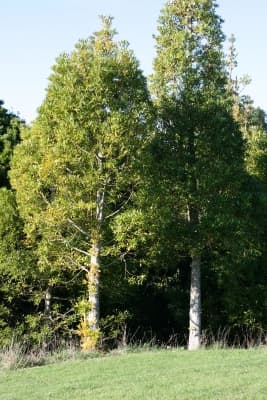
Agathis macrophylla
Agathis macrophylla
Safety & Hazards
None known
Cultivation Details
A plant of the moister lowland tropics and subtropics, growing in areas where the rainfall is evenly distributed throughout the year and is in the range of 1,900 - 6,000 mm[1]. The mean annual temperature is in the range 25 - 28°c[1] Most commonly found on well structured, friable, and freely drained soils[1]. Prefers a position in full sun or light shade[1], it can also tolerate quite considerable shade, though growth will be greatly reduced[2]. Young plants require sheltered, shady positions. The tree generally prefers basalt-derived clay loams and clays with a well developed upper humus layer. It has also been reported on coral limestone terraces and bordering mangrove vegetation[1]. Tree growth is poor on compacted and waterlogged soils[1]. Plants can withstand strong winds[1]. Grows well in acid soils, tolerating a pH in the range 4.0 - 7.4[1]. A long lived tree that can live for up to 1,000 years[1]. It is fairly fast-growing tree, in favourable conditions, annual growth can reach about 1 - 1.5 metres[1]. Young specimens have a vigorous taproot, whilst mature specimens have wide, spreading root systems that help stabilize soils on ridges and slopes[1]. Trees start producing flowers when about 10 years old, the seed taking two years to mature[1]. The use of selected, superior seed provenances (notably from Vanuatu) and good silviculture will enable the commercial production of timber and veneer in plantations on a 40 - 55-year rotation period[1]. For introduction into areas outside of its natural range, it is important to inoculate seedlings with appropriate mycorrhizal fungi[2]. From a plantation viewpoint, this species stands apart from most other members of the genus because of its ability to grow moderately fast and establish in open, sunny sites[1].
Propagation
Seed - no pre-treatment is required, and fresh, undamaged seeds germinate rapidly, commencing within 2 - 7 days (at 26°c and completed by 14 days[1]. Sow in containers in light shade[1]. Plant out seedlings after about 6 - 12 months when they are about 30cm tall[2, 1]. Cuttings of leading shoots[3]. Cite as: Tropical Plants Database, Ken Fern. tropical.theferns.info. 2026-02-19. <tropical.theferns.info/viewtropical.php?id=Agathis+macrophylla>
Pollinators
Wind
References
- [1]Traditional Trees of Pacific Islands — Elevitch. Craig. R. (Editor) · Permanent Agriculture Resources, Hawaii · 2006 · ISBN 0970254458 ↩︎Beautifully produced book with superb photos and detailed information on over 50 species of useful plants of the Pacific Islands.
- [2]World Agroforesty Centre — http://www.worldagroforestry.org/ ↩︎An excellent online database of a huge range of trees giving very good information on each plant - its uses, ecology, identity, propagation, pests etc.
- [3]Tropical and Subtropical Trees - A Worldwide Encyclopaedic Guide. — Barwick. M. · Thames & Hudson, London · 2004 · ISBN 0-500-51181-0 ↩︎A superb book, very concise and well written, giving a wealth of information on 400 or more species including descriptions, habitat, cultivation details and plant uses. A wealth of colour photographs bring each plant vividly to life.
- [4]IUCN Red List of Threatened Species — http://www.iucnredlist.org/ ↩︎A list of plants under threat and facing possible extinction, usually with brief details of the threats and information on habitat.
- [5]Dictionary of Economic Plants. — Uphof. J. C. Th. · Weinheim · 1959 · ISBN - ↩︎An excellent and very comprehensive guide but it only gives very short descriptions of the uses without any details of how to utilize the plants. Not for the casual reader.