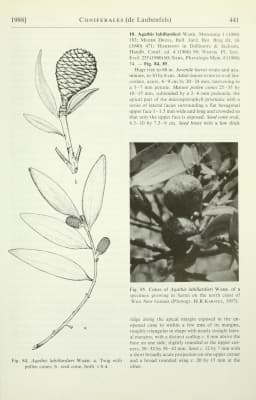
Agathis labillardieri
Agathis labillardieri
Safety & Hazards
None known
Cultivation Details
A plant of the humid tropics, where it is found at elevations up to 2,500 metres. It grows best in areas where annual daytime temperatures are within the range 24 - 32°c, but can tolerate 12 - 40°c[1]. It prefers a mean annual rainfall in the range 2,500 - 4,000mm, but tolerates 1,500 - 5,000mm[1]. Young plants grow better in the shelter and shade of the woodland, but require increasing amounts of light as they grow larger[1]. Found on a range of soils in the wild, but especially on sandy, poorly to well drained oligotrophic, somewhat podzolized soils[1]. Prefers a pH in the range 5 - 6, tolerating 4.5 - 6.5[1]. Annual height growth may be in the range of 50 - 150cm[1]. Maximum age of trees is unknown, but possibly several hundred years[1]. Annual yield of large trees can be 10 - 20 kg of resin per tree[1]. Boles smaller than 25cm in diameter should not be tapped[1].
Propagation
Seed - it cannot tolerate desiccation and does not store for much more than 2 months in normal conditions. It does not require pre-treatment. Sowing is done with the wing part of the seed pointing upwards and 66% of the seed buried in the soil. Germination commences within 6 days, with 90 - 100% germination rates within 10 days[2]. Cuttings of leading shoots[3]. Cite as: Tropical Plants Database, Ken Fern. tropical.theferns.info. 2026-02-19. <tropical.theferns.info/viewtropical.php?id=Agathis+labillardieri>
Pollinators
Wind
References
- [1]Ecocrop — http://ecocrop.fao.org/ecocrop/srv/en/home ↩︎Basic information on a wide range of useful plants, plus details of environmental needs where available.
- [2]Seed Leaflets — Various · Forest & Landscape. Denmark · http://en.sl.life.ku.dk/Publikationer/Udgivelser/PopulaerPublikationer.aspx?katid={D28373CC-6EF3-4EF8-B097-6D83FABF209E}&serieid={9F1C3DB1-6E7B-4CF1-AF53-F480B0CB40EF}&sort=title ↩︎A series of leaflets, jointly produced by the University of Copenhagen and the Royal Botanic Gardens at Kew, focussing on seed information for a number species, but also giving a lot of other information about each plant.
- [3]Tropical and Subtropical Trees - A Worldwide Encyclopaedic Guide. — Barwick. M. · Thames & Hudson, London · 2004 · ISBN 0-500-51181-0 ↩︎A superb book, very concise and well written, giving a wealth of information on 400 or more species including descriptions, habitat, cultivation details and plant uses. A wealth of colour photographs bring each plant vividly to life.
- [4]The Gymnosperm Database — http://www.conifers.org/index.htm ↩︎A vast amount of information on conifers and families of gymnosperms.
- [5]IUCN Red List of Threatened Species — http://www.iucnredlist.org/ ↩︎A list of plants under threat and facing possible extinction, usually with brief details of the threats and information on habitat.
- [6]Tropical Timbers of the World. Ag. Handbook No. 607. — Chudnoff. Martin. · USDA Forest Service. Wisconsin. · 1984 ↩︎Terse details on the properties of the wood of almost 400 species of trees from the Tropics.
- [7]Vegetable Gums and Resins. — Howes. F. N. · Faber · ISBN 81-88818-17-8 ↩︎A very good book dealing with the subject in a readable way.