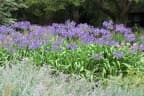
Agapanthus africanus
Agapanthus africanus
Safety & Hazards
None known
Cultivation Details
Some forms of the plant tolerate several degrees of frost[1]. They are best given a good mulch if temperatures lower than 0°c occur[1]. Succeed in most soils[2], but prefers a light very well-drained porous soil with plenty of leaf-mold[3, 1]. Plants need to be kept moderately dry during the growing season but with some moisture in winter[3]. They only flower freely if growing in a very sunny position[2]. Plants succeed in maritime gardens[4]. The rhizomes are best planted only just below soil level - a mulch of gravel or stone chips will help to keep the crown of the plant free from excess moisture[5]. This species does not usually do well in cultivation[5]. In the wild it usually only flowers freely in the year following a bush fire[5]. Hybridizes very freely with other members of this genus, some botanists say there is only one very variable species of Agapanthus[1]. Plants respond very well to division, usually flowering very freely in the year after division[6]. It is recommended that plants are divided about every 4 years[6]. Plants are usually pest and disease-free, although Agapanthus species in general are famous for harbouring snails amongst their foliage. These snails do not usually cause any damage to the plants themselves but go to neighbouring plants for food[6]. Plants seem to be immune to the predations of rabbits[4]. The flowering stems lean towards the sun[2].
Propagation
Seed - best sown in a greenhouse as soon as it is ripe[1], it can also be sown in a greenhouse in early to mid spring[7]. The seed usually germinates in 1 - 3 months at 18°c[7], do not sow it too thickly so that it is possible to grow the seedlings on in their pot without disturbing them for their first year of growth. Give occasional liquid feeds to make sure they do not become nutrient deficient. Divide the seedlings up into individual pots in the spring following germination, grow them on for a further year in the greenhouse and then plant them out into their permanent positions in late spring or early summer. Seedlings take 2 - 3 years to flower[7]. Division of offsets in mid spring. Do not move plants between early autumn and early spring[2]. Division is very easy in the growing season, the divisions can be planed straight out into their permanent positions if required. Cite as: Temperate Plants Database, Ken Fern. temperate.theferns.info. 2026-02-20. <temperate.theferns.info/plant/Agapanthus+africanus>
Pollinators
Bees
References
- [1]The New RHS Dictionary of Gardening. 1992. — Huxley. A. · MacMillan Press · 1992 · ISBN 0-333-47494-5 ↩︎Excellent and very comprehensive, though it contains a number of silly mistakes. Readable yet also very detailed.
- [2]Focus on Plants. Volume 5. (formerly 'Growing from seed') — Bird. R. (Editor) · Thompson and Morgan. · 1991 · ISBN - ↩︎Very readable magazine with lots of information on propagation. A good article on Corydalis spp.
- [3]RHS Dictionary of Plants plus Supplement. 1956 — F. Chittendon. · Oxford University Press · 1951 · ISBN - ↩︎Comprehensive listing of species and how to grow them. Somewhat outdated, it has been replaced in 1992 by a new dictionary (see [ 200 ]).
- [4]Perennial Garden Plants — Thomas. G. S. · J. M. Dent & Sons, London. · 1990 · ISBN 0 460 86048 8 ↩︎A concise guide to a wide range of perennials. Lots of cultivation guides, very little on plant uses.
- [5]The Color Encyclopedia of Cape Bulbs — Manning. J. Goldblatt. P. & Snijman. D. · Timber Press, Oregon. · 2002 · ISBN 0-88192-547-0 ↩︎Excellent treatment of these plants, with good descriptions, habitat etc. Lots of high quality colour photographs.
- [6]PlantZAfrica.com — http://www.plantzafrica.com ↩︎An excellent site giving detailed descriptions and uses of many S. African plants.
- [7]Growing from Seed. Volume 1. — Rice. G. (Editor) · Thompson and Morgan. · 1987 · ISBN - ↩︎Very readable magazine with lots of information on propagation.
- [8]Flora of the Cape Peninsula. — Adamson. and Salter. ↩︎A good flora but rather short on details of habitat. Not for the casual reader.
- [9]A Dictionary of Plants Used by Man. — Usher. G. · Constable · 1974 · ISBN 0094579202 ↩︎Forget the sexist title, this is one of the best books on the subject. Lists a very extensive range of useful plants from around the world with very brief details of the uses. Not for the casual reader.
- [10]Dictionary of Economic Plants. — Uphof. J. C. Th. · Weinheim · 1959 · ISBN - ↩︎An excellent and very comprehensive guide but it only gives very short descriptions of the uses without any details of how to utilize the plants. Not for the casual reader.