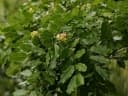
Afzelia quanzensis
Afzelia quanzensis
Safety & Hazards
A basic poison has been found in the root of this plant. It has been reported that people have been killed by ingesting the roots[1].
Cultivation Details
A plant of moist areas of the tropics, where it is found at elevations from near sea level to around 1,800 metres[2]. It prefers growing in areas where annual daytime annual temperatures fall within the range 18 - 28°c, but can tolerate 14 - 36°c[3]. Plants are sensitive to frost[2]. It grows best with a mean annual rainfall around 700 - 1,400 mm, tolerating 400 - 1,700mm, and a distinct dry season[2]. Prefers a sunny position, especially as it grows older[3]. Prefers a medium to light soil, succeeding in poor sands[2]. Requires a well-drained soil[2]. Established plants are very drought resistant[2]. Prefers a pH in the range 5 - 7, tolerating 4.5 - 7.5[3]. Plants produce a deep taproot[1]. The tree is generally slow-growing but can be quite fast on some sites, especially when young, with annual height increases of up to 60cm[4, 1]. This species has a symbiotic relationship with certain soil bacteria, these bacteria form nodules on the roots and fix atmospheric nitrogen. Some of this nitrogen is utilized by the growing plant but some can also be used by other plants growing nearby[5].
Propagation
Seed - pre-treatment is not normally necessary, but scarifying the seed by making a small scratch in the outer black layer of the seed coat can speed up germination[2]. The seeds are sown in flat seedling trays with a 5:1 mixture of river sand and compost and kept moist. Germination is usually good, reaching 90% after 28 days. Trees quickly produce a deep taproot and so should be planted out into their permanent positions whilst still small[1]. When the seedlings have reached the 2-leaf stage, they are ready for outplanting[2]. They must be protected from cold wind for the first 2 seasons[2]. Mature and properly dried seeds can be stored in airtight containers at 3°c in a cold store for several years. Seeds 10 years old may germinate, but their viability will have decreased to at most 30%[4]. Cite as: Tropical Plants Database, Ken Fern. tropical.theferns.info. 2026-02-19. <tropical.theferns.info/viewtropical.php?id=Afzelia+quanzensis>
Pollinators
Insects?
References
- [1]Indigenous multipurpose trees of Tanzania. — Hines. D.A. & Eckman. K. · 1993 · ISBN 0-9697075-0-9 ↩︎A simple handbook with information on over 50 species of trees found in Tanzania giving details of environmental requirements, cultivation needs, uses etc. It can be downloaded from the Internet.
- [2]Seed Leaflets — Various · Forest & Landscape. Denmark · http://en.sl.life.ku.dk/Publikationer/Udgivelser/PopulaerPublikationer.aspx?katid={D28373CC-6EF3-4EF8-B097-6D83FABF209E}&serieid={9F1C3DB1-6E7B-4CF1-AF53-F480B0CB40EF}&sort=title ↩︎A series of leaflets, jointly produced by the University of Copenhagen and the Royal Botanic Gardens at Kew, focussing on seed information for a number species, but also giving a lot of other information about each plant.
- [3]Ecocrop — http://ecocrop.fao.org/ecocrop/srv/en/home ↩︎Basic information on a wide range of useful plants, plus details of environmental needs where available.
- [4]World Agroforesty Centre — http://www.worldagroforestry.org/ ↩︎An excellent online database of a huge range of trees giving very good information on each plant - its uses, ecology, identity, propagation, pests etc.
- [5]The New RHS Dictionary of Gardening. 1992. — Huxley. A. · MacMillan Press · 1992 · ISBN 0-333-47494-5 ↩︎Excellent and very comprehensive, though it contains a number of silly mistakes. Readable yet also very detailed.
- [6]Sturtevant's Edible Plants of the World. — Hedrick. U. P. · Dover Publications · 1972 · ISBN 0-486-20459-6 ↩︎Lots of entries, quite a lot of information in most entries and references.
- [7]Useful Plants of Nyasaland — Williamson J. · The Government Printer, Zomba, Nyasaland. · 1955 · http://www.biodiversitylibrary.org ↩︎Brief details of the uses of almost 500 species of plants.
- [8]Botanical Beads — Smith R.J. · http://www.botanicalbeads.com/ ↩︎A website looking at seeds that are used for ornament. It is based on a book that the author had written.
- [9]The Leguminosae; A Source Book of Characteristics, Uses and Nodulation — Allen O.N.; Allen E.K. · University of Wisconsin · 1981 · ISBN 0-333-32221-5 ↩︎An amazing and comprehensive work, giving a brief guide to the many genera of the family Fabaceae and also the principle uses of the genus.
- [10]Tropical Timbers of the World. Ag. Handbook No. 607. — Chudnoff. Martin. · USDA Forest Service. Wisconsin. · 1984 ↩︎Terse details on the properties of the wood of almost 400 species of trees from the Tropics.
- [PFAF]Plants for a Future — pfaf.org ↩︎