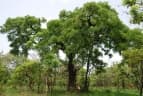
Cultivation Details
A plant of the lowland moist tropics where it can be found at elevations up to 900 metres[4]. It grows best in areas where annual daytime temperatures are within the range 20 - 32°c, but can tolerate 10 - 40°c[4]. It prefers a mean annual rainfall in the range 1,200 - 1,800mm, but tolerates 1,000 - 2,500mm[4]. Requires a sunny position, though young plants can tolerate light shade[1, 2]. Found in the wild in well watered sites with a deep sandy soil, though it can adapt to lateritic soils[2, 4]. Grows best in a fertile soil[4]. Prefers a pH in the range 5.5 - 6.5, tolerating 5 - 7[4]. Plants can tolerate occasional inundation of the soil[4]. The tree will resprout if cut back to the old wood[5]. The tree is not tolerant of fires[2]. The tree can resist fires[4]. Although most species in the family Fabaceae have a symbiotic relationship with bacteria on their roots that can fix atmospheric nitrogen, there is a report that this species does not have this relationship.
Propagation
Seed. In germination experiments it was found that seeds that have been scarified by removing part of the seedcoat required 8 days to initiate germination and 100% germination was achieved by day 14 at 25°c[3]. The seeds germinated even when the outer seed coat was completely covered with fungi[3]. The seeds did not germinate at 10°c, whilst germination occurred by day 11 at 20°c and by day 7 at 30°c[3]. The optimum temperature for germination was 25°c, with incubated seeds having less fungi, and maximum germination was reached within two weeks at both 25°c and 30°c[3]. The seeds vary in their sizes, and while smaller seeds tend to germinate more rapidly, the seedlings from larger seeds have higher relative growth rates[3]. Cite as: Tropical Plants Database, Ken Fern. tropical.theferns.info. 2026-02-19. <tropical.theferns.info/viewtropical.php?id=Afzelia+africana>
Pollinators
Data unavailable
References
- [1]World Agroforesty Centre — http://www.worldagroforestry.org/ ↩︎An excellent online database of a huge range of trees giving very good information on each plant - its uses, ecology, identity, propagation, pests etc.
- [2]Grassland Species - Profiles — http://www.fao.org/ag/AGP/AGPC/doc/Gbase/Default.htm ↩︎Terse information on over 650 species of plants that grow in grassland, including trees, shrubs and perennial plants as well as grasses. Gives a brief description of the plant, its range and habitat and some of its uses.
- [3]Seed Leaflets — Various · Forest & Landscape. Denmark · http://en.sl.life.ku.dk/Publikationer/Udgivelser/PopulaerPublikationer.aspx?katid={D28373CC-6EF3-4EF8-B097-6D83FABF209E}&serieid={9F1C3DB1-6E7B-4CF1-AF53-F480B0CB40EF}&sort=title ↩︎A series of leaflets, jointly produced by the University of Copenhagen and the Royal Botanic Gardens at Kew, focussing on seed information for a number species, but also giving a lot of other information about each plant.
- [4]Ecocrop — http://ecocrop.fao.org/ecocrop/srv/en/home ↩︎Basic information on a wide range of useful plants, plus details of environmental needs where available.
- [5]Traditional Vegetables in Benin — Achigan-Dako E. Et al · Darwin Initiative; International Foundation for Science · 2009 ↩︎Issued as a PDF on the Internet, it contains basic information on over 250 species of plants used for food in Benin.
- [6]Dictionary of Economic Plants. — Uphof. J. C. Th. · Weinheim · 1959 · ISBN - ↩︎An excellent and very comprehensive guide but it only gives very short descriptions of the uses without any details of how to utilize the plants. Not for the casual reader.
- [7]The Leguminosae; A Source Book of Characteristics, Uses and Nodulation — Allen O.N.; Allen E.K. · University of Wisconsin · 1981 · ISBN 0-333-32221-5 ↩︎An amazing and comprehensive work, giving a brief guide to the many genera of the family Fabaceae and also the principle uses of the genus.
- [8]Tropix 7 — CIRAD · http://tropix.cirad.fr/en ↩︎An on-line guide to the timbers of 245 species of trees.