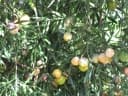
Afrocarpus falcatus
Afrocarpus falcatus
Safety & Hazards
None known
Cultivation Details
A tree of higher elevations in the tropics, descending to sea level in the subtropics. It is found in the tropics at elevations from 1,550 - 3,000 metres. It grows best in areas where annual daytime temperatures are within the range 13 - 20°c, but can tolerate 8 - 35°c[1]. When dormant, the plant can survive temperatures down to about -2°c, but young growth can be severely damaged at 0°c[1]. It prefers a mean annual rainfall in the range 1,200 - 1,800mm, but tolerates 800 - 2,200mm[1]. Succeeds in sun or light shade, young plants tolerating fairly deep shade[2]. Prefers a well-drained, deep, humus-rich and light-textured soil[2]. Prefers a pH in the range 5 - 7, tolerating 4.5 - 7.5[2, 1]. Plants cannot tolerate drought[2]. When transplanting the seedling into the open ground, care must be taken not to damage the taproot, as it will result in a long period, sometimes up to a year, during which the tree will show no growth[3]. A fast growing species, with a mean annual increment of up to 1 metre for the first 15 years; the growth rate is higher under natural conditions in higher rainfall areas and can be very fast under garden conditions[3]. Trees can commence fruiting when they are about 10 years old from seed[2]. It can take about 12 months for the seed to develop and it can then hang on the tree for a considerable time[2]. There is typically heavy seeding at intervals of 2 - 4 years[3]. On good sites trees should be large enough for harvesting for their wood 40 - 50 years after planting[3]. Trees live for a long time - perhaps 600 years[2]. A dioecious species - both male and female forms must be grown if fruit and seed are required[2].
Propagation
Seed - remains viable for several years in normal storage. The seed has two types of dormancy; a chemical, which is overcome by removing the fleshy layer and a mechanical, imposed by the hard seedcoat. To ensure a high and even germination the seedcoat must be broken and removed. This can be done in a vice but it is very time-consuming. Freshly collected seeds will normally germinate well, up to 60% in nine weeks, even with seedcoat but once the seeds have been dried, germination can take more than six months unless the seedcoat is removed. Some reports say that soaking in saturated salt water just before sowing can improve germination. Others recommend stratification between two layers of compost for 3 - 5 days in order to weaken the seedcoat[4]. The seeds are sown directly in nursery bags or in seedbeds in a mixture of compost and sand (1:1). The seed must be pushed into the mixture and covered with a fine layer of soil. The mixture must never be allowed to dry out[4]. Cuttings taken from end shoots (as opposed to cuttings from lateral branches and shoots) in order to produce plants with upright growth[4]. Cite as: Tropical Plants Database, Ken Fern. tropical.theferns.info. 2026-02-19. <tropical.theferns.info/viewtropical.php?id=Afrocarpus+falcatus>
Pollinators
Wind
References
- [1]Ecocrop — http://ecocrop.fao.org/ecocrop/srv/en/home ↩︎Basic information on a wide range of useful plants, plus details of environmental needs where available.
- [2]Protabase - Plant Resources of Tropical Africa. — http://www.prota.org ↩︎An excellent on-line database with detailed information on over 3,200 species of useful plants of Africa.
- [3]World Agroforesty Centre — http://www.worldagroforestry.org/ ↩︎An excellent online database of a huge range of trees giving very good information on each plant - its uses, ecology, identity, propagation, pests etc.
- [4]Seed Leaflets — Various · Forest & Landscape. Denmark · http://en.sl.life.ku.dk/Publikationer/Udgivelser/PopulaerPublikationer.aspx?katid={D28373CC-6EF3-4EF8-B097-6D83FABF209E}&serieid={9F1C3DB1-6E7B-4CF1-AF53-F480B0CB40EF}&sort=title ↩︎A series of leaflets, jointly produced by the University of Copenhagen and the Royal Botanic Gardens at Kew, focussing on seed information for a number species, but also giving a lot of other information about each plant.
- [5]The Gymnosperm Database — http://www.conifers.org/index.htm ↩︎A vast amount of information on conifers and families of gymnosperms.
- [6]IUCN Red List of Threatened Species — http://www.iucnredlist.org/ ↩︎A list of plants under threat and facing possible extinction, usually with brief details of the threats and information on habitat.
- [7]Field Guide to the Moist Forest Trees of Tanzania. — Lovett J.C.; Ruffo C.K.; Gereau R.E.; Taplin J.R.D · Frontier · http://www.york.ac.uk/res/celp/webpages/projects/ecology/tree%20guide/introduction.htm · ISBN 1-873070-33-0 ↩︎A lovely little book giving a basic identification guide to more than 650 species of trees growing in Tanzania. It is also available to view on the internet.
- [8]PlantZAfrica.com — http://www.plantzafrica.com ↩︎An excellent site giving detailed descriptions and uses of many S. African plants.