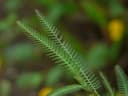
Aeschynomene indica
Aeschynomene indica
Safety & Hazards
There are reports that the plant may sometimes be toxic to animals[1].
Cultivation Details
A plant of the warm temperate zone through to the tropics, where it is found at elevations from sea level up to 1,530 metres. It grows best in areas where annual daytime temperatures are within the range 18 - 30°c, but can tolerate 10 - 35°c[1]. It prefers a mean annual rainfall in the range 1,000 - 1,200mm, but tolerates 600 - 2,000mm[1]. Grows best in a sunny position[1]. The plant is largely found on soils with a texture ranging from sandy loam to clay, but is also sometimes found on black saline soils[1]. Prefers a pH in the range 5.5 - 6.5, tolerating 4.5 - 8[1]. Spreading freely at times by means of its seeds, it can become a serious weed in rice paddies[2]. It is considered to be an invasive weed in some areas of the tropics[3]. This species has a symbiotic relationship with certain soil bacteria, these bacteria form nodules on the roots and fix atmospheric nitrogen. Some of this nitrogen is utilized by the growing plant but some can also be used by other plants growing nearby[4]. If removing the plant at the end of the growing season, then it is best to cut it at ground level and leave the roots in the ground, since this will also leave the nitrogen for the next crop.
Propagation
Seed - it has a hard seedcoat and may benefit from scarification before sowing to speed up germination[2]. This can usually be done by pouring a small amount of nearly boiling water on the seeds (being careful not to cook them!) and then soaking them for 12 - 24 hours in warm water. By this time they should have imbibed moisture and swollen - if they have not, then carefully make a nick in the seedcoat (being careful not to damage the embryo) and soak for a further 12 hours before sowing. Cite as: Tropical Plants Database, Ken Fern. tropical.theferns.info. 2026-02-19. <tropical.theferns.info/viewtropical.php?id=Aeschynomene+indica>
Pollinators
Data unavailable
References
- [1]Ecocrop — http://ecocrop.fao.org/ecocrop/srv/en/home ↩︎Basic information on a wide range of useful plants, plus details of environmental needs where available.
- [2]Tropical Forages — http://www.tropicalforages.info/key/Forages/Media/Html/index.htm ↩︎Mainly focussed on forage plants, the site gives a lot of information on the plant, with a good botanical description, details of cultivation, plant uses and a good selection of photographs.
- [3]Pacific Island Ecosystems at Risk — http://www.hear.org/pier/scientificnames/index.html ↩︎A very good website detailing weed species that have been introduced into the Pacific Islands.
- [4]The New RHS Dictionary of Gardening. 1992. — Huxley. A. · MacMillan Press · 1992 · ISBN 0-333-47494-5 ↩︎Excellent and very comprehensive, though it contains a number of silly mistakes. Readable yet also very detailed.
- [5]IUCN Red List of Threatened Species — http://www.iucnredlist.org/ ↩︎A list of plants under threat and facing possible extinction, usually with brief details of the threats and information on habitat.
- [6]Cornucopia II — Facciola. S. · Kampong Publications, California. · 1998 · ISBN 0-9628087-2-5 ↩︎The second edition of an excellent guide to the edible uses of plants, though it does not give any details of cultivation etc.
- [7]Plant Resources of Southeast Asia — http://proseanet.org/ ↩︎Lots of information on the uses of the plants of SE Asia.
- [8]Grassland Species - Profiles — http://www.fao.org/ag/AGP/AGPC/doc/Gbase/Default.htm ↩︎Terse information on over 650 species of plants that grow in grassland, including trees, shrubs and perennial plants as well as grasses. Gives a brief description of the plant, its range and habitat and some of its uses.