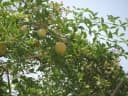
Cultivation Details
The plant is a hardy, deciduous tree that can be grown in tropical and sub-tropic areas, being tolerant of harsh conditions, including extremes of temperature[2]. It succeeds from sea level to an elevation of 1,200 metres where the mean annual temperature can range from -6 to 48°c[1]. In Thailand, it only flowers and fruits well where there is a prominent dry season[2]. Does best on rich, well-drained soils[1], but can tolerate poor soils and alkaline conditions[2]. It also grows well in swampy, alkaline or stony soils having pH range from 5 to 8[1]. It has gained the reputation of thriving where other fruit trees cannot survive[1]. Plants are very drought tolerant[1]. Seedling trees begin to crop when 6 - 7 years old, vegetatively propagated plants bear fruit after 5 years and full bearing can be attained in about 15 years[2]. A tree may yield as many as 800 fruits in a season but an average crop is 150 to 200, or, in the better cultivars, up to 400[1]. The fruit ripens in the dry season when most leaves have been shed in anticipation of bloom for the next crop[2]. The plant responds well to coppicing[3].
Propagation
Seed - the plant is commonly grown from seed in nurseries and transplanted into the field[1]. Seedlings show great variation in form, size, texture of rind, quantity and quality of pulp and number of seeds[1]. Root suckers[2]. Budding onto seedling stocks. Cite as: Tropical Plants Database, Ken Fern. tropical.theferns.info. 2026-02-19. <tropical.theferns.info/viewtropical.php?id=Aegle+marmelos>
Pollinators
Data unavailable
References
- [1]World Agroforesty Centre — http://www.worldagroforestry.org/ ↩︎An excellent online database of a huge range of trees giving very good information on each plant - its uses, ecology, identity, propagation, pests etc.
- [2]Under-Utilized Tropical Fruits of Thailand. RAP — Suranant Subhadrabandhu · F. A. O., The United Nations, Bangkok. · 2001 · http://www.fao.org/3/a-ab777e.pdf ↩︎A detailed report on 35 fruit species that could have potential for increased production in Thailand. The report can be downloadd as a PDF from the internet.
- [3]Digital Compendium of Forestry Species of Cambodia — www.digitalspecies.blogspot.com; Phnom Penh · 2008 · http://www.digitalspecies.blogspot.com ↩︎A very detailed booklet, produced in PDF format on the internet, giving information on around 100 species of trees.
- [4]Trees Commonly Cultivated in SE Asia — Jensen. M. · FAO Regional Office, Bangkok. · 1999 · ISBN 974-89377-5-5 ↩︎
- [5]Brazilian Fruits and Cultivated Exotics — Lorenzi. H.; Bacher. L.; Lacerda. M.; Sartori. S. · Instituto Plantarum De Estudos Da Flora LTDA; Brazil. · 2000 · ISBN 85-867174-24-0 ↩︎A superb book, giving information on several hundred fruit species. Each entry has a brief description of the plant and its uses, accompanied by one to many excellent quality photographs of the fruits.
- [6]Trade in Indian Medicinal Plants — D.K.Ved, S.Noorunnisa Begum, & K.Ravi Kumar · Apple Academic Press; Oakville, Canada · 2018 · ISBN 978-1-77188-600-0 ↩︎
- [7]Flora of Pakistan — http://www.efloras.org ↩︎As of 2006, there is not much information on habitats available, but it is being developed and promises to be an excellent resource.
- [8]Cornucopia II — Facciola. S. · Kampong Publications, California. · 1998 · ISBN 0-9628087-2-5 ↩︎The second edition of an excellent guide to the edible uses of plants, though it does not give any details of cultivation etc.
- [9]The Encyclopedia of Medicinal Plants — Chevallier. A. · Dorling Kindersley. London · 1996 · ISBN 9-780751-303148 ↩︎An excellent guide to over 500 of the more well known medicinal herbs from around the world.
- [10]Tropical and Subtropical Trees - A Worldwide Encyclopaedic Guide. — Barwick. M. · Thames & Hudson, London · 2004 · ISBN 0-500-51181-0 ↩︎A superb book, very concise and well written, giving a wealth of information on 400 or more species including descriptions, habitat, cultivation details and plant uses. A wealth of colour photographs bring each plant vividly to life.
- [11]Plants and People of Nepal — Manandhar. N. P. · Timber Press. Oregon. · 2002 · ISBN 0-88192-527-6 ↩︎Excellent book, covering over 1,500 species of useful plants from Nepal together with information on the geography and peoples of Nepal. Good descriptions of the plants with terse notes on their uses.