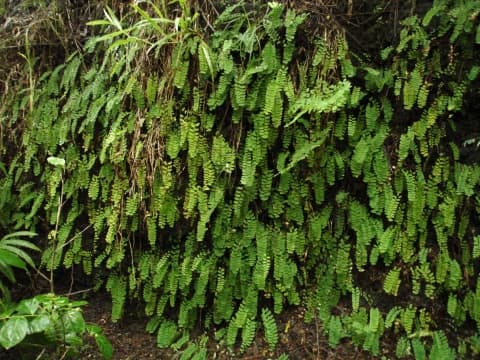
Adiantum lunulatum
Adiantum lunulatum
Safety & Hazards
Although we have found no reports of toxicity for this species, a number of ferns contain carcinogens so some caution is advisable[1]. Many ferns also contain thiaminase, an enzyme that robs the body of its vitamin B complex. In small quantities this enzyme will do no harm to people eating an adequate diet that is rich in vitamin B, though large quantities can cause severe health problems. The enzyme is destroyed by heat or thorough drying, so cooking the plant will remove the thiaminase[2].
Cultivation Details
Not known
Propagation
Spores. Division of new plants formed at the apex of the fronds[1]. Cite as: Tropical Plants Database, Ken Fern. tropical.theferns.info. 2026-02-19. <tropical.theferns.info/viewtropical.php?id=Adiantum+lunulatum>
Pollinators
Data unavailable
References
- [1]The New RHS Dictionary of Gardening. 1992. — Huxley. A. · MacMillan Press · 1992 · ISBN 0-333-47494-5 ↩︎Excellent and very comprehensive, though it contains a number of silly mistakes. Readable yet also very detailed.
- [2]Discovering Wild Plants - Alaska, W. Canada and the Northwest. — Schofield. J. J. · Alaska Northwest Books; Alaska · 2003 · ISBN 0882403699 ↩︎A nice guide to some useful plants in that area.
- [3]The Botany of Bihar and Orissa — Haines H.H. · Adlard & Son & West Newman Ltd. London · 1922 · http://www.biodiversitylibrary.org ↩︎A flora, it gives many plant uses. The book can be downloaded from the Internet.
- [4]Ferns and Fern Allies of Guatemala — Field Museum of Natural History · 1981 · http://www.biodiversitylibrary.org ↩︎A flora of the ferns of Guatemala, giving some plant uses. It can be downloaded from the Internet.
- [5]American Fern Journal Vol.60 — American Fern Society · 1970 · http://www.biodiversitylibrary.org ↩︎Contains an article on the medicinal uses of Indian ferns. It can be downloaded from the Internet.