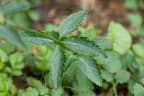
Adenophora triphylla
Adenophora triphylla
Safety & Hazards
None known
Cultivation Details
Adenophora triphylla has a wide range from the cold, temperate zone of the Russian Federation south to the tropics of Vietnam and Laos. It is usually found at low elevations in the north of its range, but is more likely to be found at higher elevations towards the south - it is found up to 2,000 metres in southern China[1]. Plants, at least those obtained from the north of its range, are hardy to about -20°c, perhaps even lower if the soil is reliably well-drained[2, 3]. Prefers a light rich slightly alkaline soil that is not too dry and a warm sunny position[4, 3]. Prefers a moist peaty soil in sun or partial shade[2]. This species is extremely polymorphic, and several varieties and forms have been described in Japan. The many variations in several characters (hairiness, leaf-shape, inflorescence-shape etc.) can be seen in individuals growing intermixed[5]. This species succeeds in a meadow if the grass is not cut until after the plant flowers[3]. Intolerant of root disturbance[4]. The young growth is extremely attractive to slugs, they have been known to destroy even mature plants[PFAF].
Propagation
Seed - best sown in a cold frame as soon as it is ripe[3]. The seed can also be sown in spring. Surface sow 2 - 3 seeds per pot in the spring in order to avoid transplanting[6]. We have found that if transplanted when very small seedlings grow away without difficulty[PFAF]. Germinates in 1 - 3 months at 10°c[6]. Plant out into their permanent positions whilst young. Basal cuttings in spring[PFAF]. Cite as: Temperate Plants Database, Ken Fern. temperate.theferns.info. 2026-02-20. <temperate.theferns.info/plant/Adenophora+triphylla>
Pollinators
Insects
References
- [1]Flora of China — Missouri Botanical Garden Press; St. Louis. · 1994 · http://flora.huh.harvard.edu/china/ ↩︎An excellent, comprehensive resource in 25 volumes. In addition to the botanical information the flora also gives basic information on habitat and some uses. An on-line version is also available.
- [2]Perennials. Volumes 1 and 2. — Phillips. R. & Rix. M. · Pan Books · 1991 · ISBN 0-330-30936-9 ↩︎Photographs of over 3,000 species and cultivars of ornamental plants together with brief cultivation notes, details of habitat etc.
- [3]The New RHS Dictionary of Gardening. 1992. — Huxley. A. · MacMillan Press · 1992 · ISBN 0-333-47494-5 ↩︎Excellent and very comprehensive, though it contains a number of silly mistakes. Readable yet also very detailed.
- [4]RHS Dictionary of Plants plus Supplement. 1956 — F. Chittendon. · Oxford University Press · 1951 · ISBN - ↩︎Comprehensive listing of species and how to grow them. Somewhat outdated, it has been replaced in 1992 by a new dictionary (see [ 200 ]).
- [5]Flora of Japan — http://www.foj.info ↩︎An on-line version of the flora - an excellent resource.
- [6]Growing from Seed. Volume 1. — Rice. G. (Editor) · Thompson and Morgan. · 1987 · ISBN - ↩︎Very readable magazine with lots of information on propagation.
- [7]Flora of the USSR. — Komarov. V. L. · Israel Program for Scientific Translation · 1968 · http://www.biodiversitylibrary.org · ISBN - ↩︎An immense (25 or more large volumes) and not yet completed translation of the Russian flora. Full of information on plant uses and habitats but heavy going for casual readers. It can be downloaded from the Internet.
- [8]Wild Food Plants in South Korea; Market Presence, New Crops, and Exports to the United States — Pemberton R.W. & Nam Sook Lee · 1996 · http://www.jstor.org/stable/4255805 ↩︎
- [9]Dictionary of Economic Plants. — Uphof. J. C. Th. · Weinheim · 1959 · ISBN - ↩︎An excellent and very comprehensive guide but it only gives very short descriptions of the uses without any details of how to utilize the plants. Not for the casual reader.
- [10]A Dictionary of Plants Used by Man. — Usher. G. · Constable · 1974 · ISBN 0094579202 ↩︎Forget the sexist title, this is one of the best books on the subject. Lists a very extensive range of useful plants from around the world with very brief details of the uses. Not for the casual reader.
- [11]Tanaka's Cyclopedia of Edible Plants of the World. — Tanaka. T. & Nakao S. · Keigaku Publishing; Tokyo · 1976 · ISBN - ↩︎The most comprehensive list of edible plants I've come across. Only the briefest entry for each species, though, and some of the entries are more than a little dubious. Not for the casual reader.
- [12]Plants for Human Consumption. — Kunkel. G. · Koeltz Scientific Books · 1984 · ISBN 3874292169 ↩︎An excellent book for the dedicated. A comprehensive listing of Latin names with a brief list of edible parts.
- [13]Atlas of Medicinal Plants. — Kariyone. T. · Nihon Rinshosha; Osaka · 1973 ↩︎A good Japanese herbal.
- [14]Handbook of Chinese Herbs and Formulas. — Yeung. Him-Che. · Institute of Chinese Medicine, Los Angeles · 1985 · ISBN - ↩︎An excellent Chinese herbal giving information on over 500 species. Rather technical and probably best suited to the more accomplished user of herbs.
- [15]Medicinal Plants of China — Duke. J. A. and Ayensu. E. S. · Reference Publications, Inc. · 1985 · ISBN 0-917256-20-4 ↩︎Details of over 1,200 medicinal plants of China and brief details of their uses. Often includes an analysis, or at least a list of constituents. Heavy going if you are not into the subject.
- [16]Medicinal Plants in the Republic of Korea — World Health Organisation, Manila · 1998 · ISBN 92 9061 120 0 ↩︎An excellent book with terse details about the medicinal uses of the plants with references to scientific trials. All plants are described, illustrated and brief details of habitats given.
- [PFAF]Plants for a Future — pfaf.org ↩︎