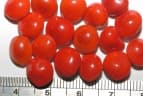
Adenanthera pavonina
Adenanthera pavonina
Safety & Hazards
The raw seeds are poisonous[1].
Cultivation Details
A plant of the humid, lowland tropics and subtropics, where it is found at elevations up to 400 metres[1, 2]. It grows best in areas where annual daytime temperatures are within the range 22 - 28°c, but can tolerate 12 - 36°c[2]. It prefers a mean annual rainfall in the range 3,000 - 5,000mm, but tolerates 2,000 - 6,000mm[2]. Prefers a sunny position, tolerating light shade[2]. Succeeds in any moderately fertile, moisture-retentive soil[3]. It is found in the wild on a variety of soils, from deep, well-drained to shallow and rocky[2]. Prefers a pH in the range 5 - 7, tolerating 4.5 - 7.5[2]. Established plants are drought tolerant[4]. Requires a position sheltered from high winds[1]. Plants can become invasive in lowland regions[4]. Growth is initially slow but increases rapidly after the first year, during which average annual growth rates of 23 - 26mm in diameter and 200 - 230cm in height can be attained[1]. Trees planted 1 x 2 metres apart for windbreaks and at 2 x 2 metres in plantations can be thinned in 3 - 5 years to provide fuel wood and construction materials[1]. For shade trees, spacing varies from 5 to 10 metres, depending on the companion crop and site[1]. Plants can flower and produce fruit all year round[5]. Trees resprout easily, allowing for coppice management with good survival[1]. The tree is susceptible to breakage in high winds, with most of the damage occurring in the crown[1, 2]. The seeds are fairly uniform and were traditionally used as weights by apothecaries and goldsmiths - each seed weighing nearly 4grains (0.25g)[4]. This species has a symbiotic relationship with certain soil bacteria, these bacteria form nodules on the roots and fix atmospheric nitrogen. Some of this nitrogen is utilized by the growing plant but some can also be used by other plants growing nearby[3]. The tree is often found without any nodules or only sparsely furnished with nodules[6].
Propagation
Seed - the seedcoat is extremely hard and requires scarification, otherwise germination may take 12 months or more[1]. This is easiest to carry out by pre-soaking the seed for 12- 24 hours in warm water[PFAF]. Treated seed can give 100% germination in as little as 1 - 4 days, though 10 days is more usual[1]. The seed can be sown in situ, in nursery beds or in containers[3, 1]. Young seedlings attain a height of 8 - 30 cm in approximately 3 months. Nodal cuttings in sand in a closed case[3]. The seed can be stored for several years in sealed containers at room temperature[1]. Propagation from large cuttings is reported to be successful in India[1]. Cite as: Tropical Plants Database, Ken Fern. tropical.theferns.info. 2026-02-19. <tropical.theferns.info/viewtropical.php?id=Adenanthera+pavonina>
Pollinators
Insects
References
- [1]World Agroforesty Centre — http://www.worldagroforestry.org/ ↩︎An excellent online database of a huge range of trees giving very good information on each plant - its uses, ecology, identity, propagation, pests etc.
- [2]Ecocrop — http://ecocrop.fao.org/ecocrop/srv/en/home ↩︎Basic information on a wide range of useful plants, plus details of environmental needs where available.
- [3]The New RHS Dictionary of Gardening. 1992. — Huxley. A. · MacMillan Press · 1992 · ISBN 0-333-47494-5 ↩︎Excellent and very comprehensive, though it contains a number of silly mistakes. Readable yet also very detailed.
- [4]Tropical and Subtropical Trees - A Worldwide Encyclopaedic Guide. — Barwick. M. · Thames & Hudson, London · 2004 · ISBN 0-500-51181-0 ↩︎A superb book, very concise and well written, giving a wealth of information on 400 or more species including descriptions, habitat, cultivation details and plant uses. A wealth of colour photographs bring each plant vividly to life.
- [5]Medicinal Plants in Papua New Guinea — World Health Organisation · 2009 · ISBN 978-92-9061-249-0 ↩︎Traditional medicinal uses of 126 species from Papua New Guinea, including information on modern research into the plants.
- [6]The Leguminosae; A Source Book of Characteristics, Uses and Nodulation — Allen O.N.; Allen E.K. · University of Wisconsin · 1981 · ISBN 0-333-32221-5 ↩︎An amazing and comprehensive work, giving a brief guide to the many genera of the family Fabaceae and also the principle uses of the genus.
- [7]Medicinal Plants in the South Pacific — WHO Regional Publications, Manilla. · 1998 · ISBN 92-9061-118-9 ↩︎Excellent guide to 102 medicinal herbs of the Pacific Islands, with photographs of each plant and details of their constituents, biological activities and traditional uses. A description of each plant, together with habitat and distribution is given.
- [8]Cornucopia II — Facciola. S. · Kampong Publications, California. · 1998 · ISBN 0-9628087-2-5 ↩︎The second edition of an excellent guide to the edible uses of plants, though it does not give any details of cultivation etc.
- [9]Dictionary of Economic Plants. — Uphof. J. C. Th. · Weinheim · 1959 · ISBN - ↩︎An excellent and very comprehensive guide but it only gives very short descriptions of the uses without any details of how to utilize the plants. Not for the casual reader.
- [10]The Useful Plants of the Island of Guam — Safford W.E. · Smithsonian Institute; Washington. · 1905 · http://www.biodiversitylibrary.org/ ↩︎A very comprehensive, if rather dated, guide to the plants of Guam. It can be downloaded from the Internet.
- [PFAF]Plants for a Future — pfaf.org ↩︎