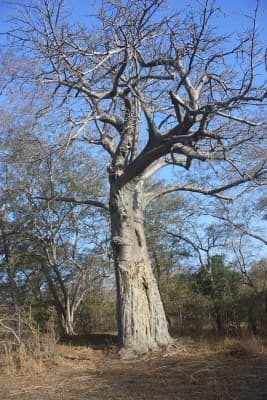
Adansonia digitata
Adansonia digitata
Safety & Hazards
The bark is boiled for days to extract a substance poisonous to ants[1].
Cultivation Details
Plants succeed in the lowland drier tropics up to an elevation of 1,500 metres[1]. They grow best in areas with a mean annual temperature in the range 20 - 30°c[2]. They prefer a mean annual rainfall of 250 - 1,000mm, but can tolerate it as low as 100mm or as high as 1,500mm[1]. They cannot succeed in areas subject to frost, being able to tolerate no more than one day of frost each year[1]. Requires a position in full sun in a sandy, well-drained soil[3]. Plants do not grow in deep sandy soils, presumably because they are unable to obtain sufficient anchorage and moisture, but are commonly found in sandy soils overlying loam and with a high water table[1]. Established plants are very drought tolerant[1]. Prefers an acidic soil with a pH lower than 6.5[1]. After reasonably fast growth when very young[1], it becomes a very slow-growing and long-lived tree, with some gnarled specimens believed to be around 2,000 years old[3]. The thick, fibrous bark is remarkably fire resistant, and even if the interior is completely burnt out, the tree continues to live[1]. The wood inside the bark is unusually soft - hollowed out trees have been used as bars, shops and even prisons[4]. Plants are resistant to termites[1]. The baobab is a popular species for bonsai specimens[1]. In dry regions, the baobab plays a vital role in water storage; a hollowed trunk may be carved out in 3 - 4 days. A medium-sized tree may hold 400 gallons while a large tree could contain over 2,000 gallons, and water stored in them is said to remain sweet for several years if the hollow is kept well closed The flowers emit what some describe as a strong carrion smell, which is presumably attractive to the bats[1].
Propagation
Seed - sow in containers. Germination is usually 90-100% and takes 1-3 months at 21c[3, 1]. Germination is more rapid and successful if the seeds are first nicked or boiling water is poured on them, after which they are left to soak for 24 hours[1]. Soaking in water overnight softens the seed coat and makes water absorption for germination easy[1]. When the seed coat is nicked it may take only 6 days to germinate[1], though it is more likely to be 15 - 40 days[2]. It is preferable to sow the seed directly into the soil[1]. When seedlings emerge it is best to shade them for 8 days, then provide half shade for 4 - 7 days before exposing them to full sun[2]. Seedlings need to be 3 - 4 months old, reaching a height of 40 - 50cm, before transplanting[2]. The seed can be stored for at least 4 years at room temperature with no loss of viability[2]. Cite as: Tropical Plants Database, Ken Fern. tropical.theferns.info. 2026-02-19. <tropical.theferns.info/viewtropical.php?id=Adansonia+digitata>
Pollinators
Bats, Bush Babies
References
- [1]World Agroforesty Centre — http://www.worldagroforestry.org/ ↩︎An excellent online database of a huge range of trees giving very good information on each plant - its uses, ecology, identity, propagation, pests etc.
- [2]Seed Leaflets — Various · Forest & Landscape. Denmark · http://en.sl.life.ku.dk/Publikationer/Udgivelser/PopulaerPublikationer.aspx?katid={D28373CC-6EF3-4EF8-B097-6D83FABF209E}&serieid={9F1C3DB1-6E7B-4CF1-AF53-F480B0CB40EF}&sort=title ↩︎A series of leaflets, jointly produced by the University of Copenhagen and the Royal Botanic Gardens at Kew, focussing on seed information for a number species, but also giving a lot of other information about each plant.
- [3]The New RHS Dictionary of Gardening. 1992. — Huxley. A. · MacMillan Press · 1992 · ISBN 0-333-47494-5 ↩︎Excellent and very comprehensive, though it contains a number of silly mistakes. Readable yet also very detailed.
- [4]Dominica Botanic Gardens — http://www.da-academy.org/trees_shrubs.html ↩︎An on-line resource, providing top quality pictures and some basic information on various plants being grown at the Botanic Gardens, often including uses and habitat.
- [5]Cornucopia II — Facciola. S. · Kampong Publications, California. · 1998 · ISBN 0-9628087-2-5 ↩︎The second edition of an excellent guide to the edible uses of plants, though it does not give any details of cultivation etc.
- [6]Gemsbok Bean and Kalahari Truffle — Leffers A. · Gamsberg MacMillan; Namibia. · 2003 · ISBN 99916-0-491-X ↩︎Details of the traditional uses of over 200 species of plants in northeastern Namibia. Written for the non-expert, there is usually at least one photograph with each plant entry.
- [7]Trade Winds Fruit — http://www.tradewindsfruit.com/index.htm ↩︎The on-line catalogue of a company selling seeds. Gives descriptions, photos and uses of a very wide range of fruit and other food-producing plants plus ornamentals.
- [8]Flowers of India — http://www.flowersofindia.net/ ↩︎A wed site of native Indian plants, plus cultivated and naturalized species. It has good quality photos and terse details on more than 3,000 species and cultivars.
- [9]Trees and Shrubs of the Sahel. Their Characteristics and Uses. — von Maydell H. · Deutsche Gesellschaft fur Technische Zusammenarbeit; Germany · 1990 · ISBN 3-8236-1198-4 ↩︎A well-researched book, usually with more than one photograph of each species and good information on the plant and its uses.
- [10]Dictionary of Economic Plants. — Uphof. J. C. Th. · Weinheim · 1959 · ISBN - ↩︎An excellent and very comprehensive guide but it only gives very short descriptions of the uses without any details of how to utilize the plants. Not for the casual reader.
- [11]Flora and Fauna of Africa — http://www.gateway-africa.com/fuanaflora/index.html ↩︎Contains photos and basic information on the plant and its uses. So far just over 70 species appear on the site, though they say that it is a work in progress.
- [12]CosIng — http://ec.europa.eu/growth/tools-databases/cosing/ ↩︎CosIng is the European Commission database for information on cosmetic substances and ingredients.
- [13]Useful Fiber Plants of the World — Dodge C.R. · USDA; Washington. · 1897 · http://www.biodiversitylibrary.org/ ↩︎A rather dated, but very comprehensive catalogue of fibre plants from around the world. The book can be downloaded from the Internet.