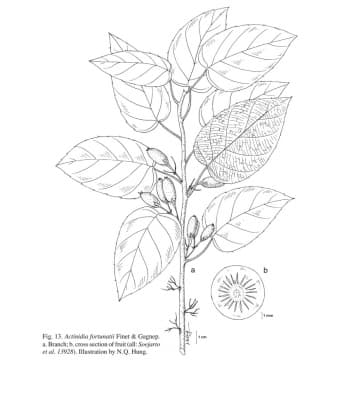
Actinidia fortunatii
Actinidia fortunatii
Safety & Hazards
None known
Cultivation Details
Actinidia fortunatii is a plant of the subtropical to tropical areas of southern China and northern Vietnam, where it is generally found at elevations around 1,000 metres[1]. It should succeed outdoors at least in the warmer areas of the temperate zone. Mature plants are likely to be able to tolerate moderate frosts, but the young growth is very susceptible to frost damage[2]. Prefers a sound loamy neutral soil[3, 4]. Succeeds in semi-shade but full sun is best for fruit production[4]. Prefers a sheltered position[4]. Fruits are formed on second year wood and also on fruit spurs on older wood[5], any pruning is best carried out in the winter[6]. This is a climbing plant, supporting itself by twining around branches etc[4]. Plants in this genus are notably resistant to honey fungus[4]. A dioecious species - both male and female forms must be grown if fruit and seed are required. Female plants produce morphologically perfect flowers with well-developed pistils and stamens, but their stamens produce nonviable pollen; flowers of male plants have small, rudimentary ovaries without viable ovules but their stamens release viable pollen[7].
Propagation
Seed - sow spring in a greenhouse[8]. It is probably best if the seed is given 3 months stratification[9], either sow it in a cold frame as soon as it is ripe in late autumn or as soon as it is received. Fresh seed germinates in 2 - 3 months at 10°c, stored seed can take longer[8]. When they are large enough to handle, prick the seedlings out into individual pots and grow them on in light shade in the greenhouse for at least their first winter. When the plants are 30cm or more tall, plant them out into their permanent positions in late spring or early summer, after the last expected frosts[PFAF]. Most seedlings are male[5]. The seedlings are subject to damping off, they must be kept well ventilated[9]. Cuttings of softwood as soon as ready in spring in a frame[PFAF]. Cuttings of half-ripe wood, mid summer in a frame. Very high percentage[9]. Cuttings of ripe wood, autumn in a frame. Cite as: Temperate Plants Database, Ken Fern. temperate.theferns.info. 2026-02-20. <temperate.theferns.info/plant/Actinidia+fortunatii>
Pollinators
Bees, Insects
References
- [1]A Taxonomic Revision of Actinidiaceae of Vietnam — Nguyen M. Cuong, Djaja D. Soejarto & Jiangquiang Li · 2007 · http://www.repository.naturalis.nl/ ↩︎A treatment of the Actinidiaceae found in Vietnam
- [2]Wonder Crops. 1987. — Natural Food Institute, ↩︎Fascinating reading, this is an annual publication. Some reports do seem somewhat exaggerated though.
- [3]RHS Dictionary of Plants plus Supplement. 1956 — F. Chittendon. · Oxford University Press · 1951 · ISBN - ↩︎Comprehensive listing of species and how to grow them. Somewhat outdated, it has been replaced in 1992 by a new dictionary (see [ 200 ]).
- [4]The New RHS Dictionary of Gardening. 1992. — Huxley. A. · MacMillan Press · 1992 · ISBN 0-333-47494-5 ↩︎Excellent and very comprehensive, though it contains a number of silly mistakes. Readable yet also very detailed.
- [5]The Plantsman. Vol. 6. 1984 - 1985. — ? · Royal Horticultural Society · 1984 · ISBN - ↩︎Excerpts from the periodical giving cultivation details and other notes on some of the useful plants including Actinidia and Wisteria species.
- [6]Gardening on Walls — Grey-Wilson. C. & Matthews. V. · Collins · 1983 · ISBN 0-00-219220-0 ↩︎A nice little book about plants for growing against walls and a small section on plants that can grow in walls.
- [7]Genetic Resources of Kiwifruit: Domestication and Breeding — A. Ross Ferguson; Hongwen Huang · John Wiley & Sons, Inc. · 2007 · ISBN 978-0-471-73214-3 ↩︎A very detailed look at the horticultural prospects of kiwifruits (Actinidia species).
- [8]Growing from Seed. Volume 1. — Rice. G. (Editor) · Thompson and Morgan. · 1987 · ISBN - ↩︎Very readable magazine with lots of information on propagation.
- [9]The Reference Manual of Woody Plant Propagation. — Dirr. M. A. and Heuser. M. W. · Athens Ga. Varsity Press · 1987 · ISBN 0942375009 ↩︎A very detailed book on propagating trees. Not for the casual reader.
- [10]Flora of China — Missouri Botanical Garden Press; St. Louis. · 1994 · http://flora.huh.harvard.edu/china/ ↩︎An excellent, comprehensive resource in 25 volumes. In addition to the botanical information the flora also gives basic information on habitat and some uses. An on-line version is also available.
- [11]Journal of the Arnold Arboretum. Vol. 33. — Li. H. L. · Harvard University · 1952 · http://www.biodiversitylibrary.org · ISBN - ↩︎A botanical magazine, it contains a monograph of the genus Actinidia. Available to download from the Internet.
- [PFAF]Plants for a Future — pfaf.org ↩︎